
A Neuro-Affirming Approach to Meaningful Communication
Some of the most meaningful communication I’ve seen in the classroom has happened before a child has said a single word.
It might be a child watching the water as it pours from one container to another, reaching towards something they want, moving closer to an activity, handing an object to an adult, making a sound or simply looking towards something that has caught their attention. These moments can be easy to overlook when we think about communication strategies for autistic children mainly in terms of the words they can say.
Over the years, working alongside autistic and neurodivergent children, I’ve become increasingly aware that meaningful communication doesn’t begin with asking a child to name something, answer a question or repeat a word. It begins when we notice what matters to the child and become a responsive communication partner within that experience.
This is the thinking behind the Shared Communication Framework.
The framework brings together five simple steps that adults can use during everyday play, learning and routines:
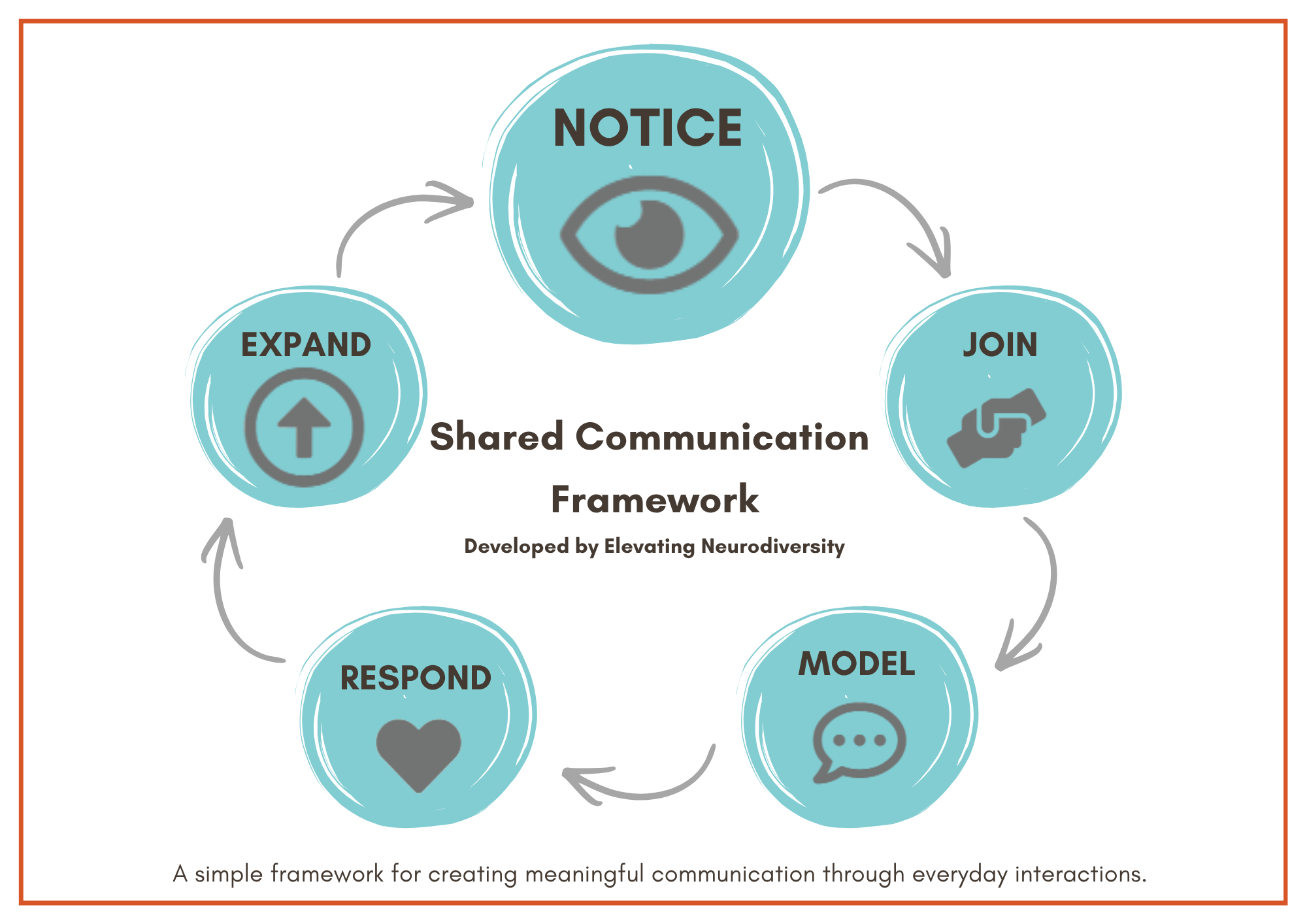
These steps are not a programme for children to complete. The have been thoughtfully curated to give adults a simple way to notice and respond to the communication that is already happening.
Communication isn’t something we teach to children. It’s something we build together.
A look, movement, sound, gesture, action or AAC selection can all be part of a shared interaction. The framework helps us recognise these moments within everyday experiences.
Our role is to notice it, join it and help it grow.
Why We Need to Think Differently About Communication
When we talk about supporting children’s communication, it can be tempting to focus on what we want a child to learn to say.
Communication is not simply about producing language. It is about sharing meaning with another person.
We might have a particular word we want them to use, a question we want them to answer, or a sentence structure we want them to produce. These approaches can have a place, but if we begin with what we want the child to produce, we can miss what the child is already communicating.
For autistic and neurodivergent learners, communication may already be happening long before they are consistently using spoken words. A child might look towards something, reach, move closer, hand an object to an adult, make a sound or take someone towards what they want. These moments can be easy to miss when we are waiting for a recognisable word or sentence.
This is where we need to shift our focus from what we want a child to say to what they are already communicating.
Communication is not simply about producing language. It is about sharing meaning with another person.
Communication may already be happening long before a child is consistently using spoken words. A child might look towards something, reach, move closer, hand an object to an adult, make a sound or take someone towards what they want. These moments can be easy to miss when we are waiting for a recognisable word or sentence.
The Shared Communication Framework starts with a different question. Instead of asking, “How can I get this child to communicate?”, we ask, “What is this child communicating right now?”
This changes our role as adults. We become communication partners who notice what matters to the child, follow their interests, join their experience and respond to their communication rather than expecting them to perform.
This is why Notice comes first. Before we model language or introduce a communication resource, we need to notice what has captured the child’s attention.

Moving away from communication as a performance
Children don’t need to demonstrate their communication skills for us to know that they are communicating. A child might know the word cow but not answer when an adult holds up a cow and asks, “What’s this?” Instead, we can join the child’s play and comment on what they are doing. If the child is putting the cow into the barn, we might say, “Cow’s going in.” The child doesn’t need to repeat the words for the interaction to be meaningful. We are sharing their attention and modelling language that connects to what they are doing.
This is why the Shared Communication Framework encourages modelling more than questioning. Comments such as “You’re pouring,” “It’s falling,” “We’re building” and “The car’s going fast” give children meaningful language without turning the interaction into a test.
Meaning comes before vocabulary
Words are more meaningful when they are connected to something the child is experiencing. A child learns pouring through actually pouring water, under through crawling under a table and falling when their tower collapses. The experience gives the language a reason to exist, so we can start with what the child is doing and build the language around it.
Visual supports and structured resources can then be introduced when they are helpful. The Shared Communication Books provide a practical way to model language during familiar play and learning experiences.
Start with the experience. Build the language around it.
Communication before correctness
Communication doesn’t have to be perfect to be meaningful. A child’s gesture, sound, movement, word, AAC selection or action can all communicate something, and our response should be to the message rather than whether the child has used the “right” word or sentence.
This doesn’t mean we stop supporting language development. It means we create opportunities for language to grow within meaningful interactions where children experience adults as people who listen, respond and share their interests.
We don't start by asking what we can teach the child to say. We start by noticing what the child is already trying to share.
What Is the Shared Communication Framework?
The Shared Communication Framework is a practical approach for creating meaningful communication through everyday interactions. It brings together five simple steps that adults can use during play, routines and learning experiences:
Notice
Before we speak, we notice.
Look at what has captured the child’s attention and what they are already doing.
Join
Follow the child’s lead.
Become part of the experience without taking over.
Model
Give language to the moment.
Comment on what is happening rather than constantly asking questions.
Respond
Every message matters.
Respond to communication in whatever form it takes.
Expand
Add one more idea.
Build on the interaction when it feels meaningful.
Shared communication begins with shared attention.
The framework gives adults a simple way to notice what matters to the child, join their experience, model meaningful language, respond to their communication and expand the interaction when it feels appropriate.
It isn’t a programme for children to complete or a set of communication skills they are expected to perform. It is a way of thinking about how we can create more opportunities for meaningful communication within the experiences that are already happening.
The framework is a way of thinking, not a script
The five steps don’t need to happen in a fixed order or look the same in every interaction. They provide a simple structure for noticing communication opportunities and responding in a way that is meaningful for the child.
Our role is to create the conditions in which communication can happen.
The Principles Behind the Shared Communication Framework
The Shared Communication Framework is built around five simple principles that guide how adults support communication in everyday interactions.
⭐ Communication Before Correctness
Communication is about sharing meaning, not saying the “right” words. We respond to every communicative attempt, including gestures, sounds, actions, AAC and speech.
⭐ Meaning Before Vocabulary
Language is most meaningful when it connects to something the child is doing, experiencing or interested in.
⭐ Follow the Child’s Lead
Notice what interests the child and join them. Use their attention and interests as opportunities for shared communication.
⭐ Model More Than You Question
Give children language without constantly asking them to respond. Comment on what is happening and model language naturally.
⭐ Start With the Action
Notice what the child is doing and build language around it.
These principles provide the foundation for the five steps of the framework: Notice, Join, Model, Respond and Expand.
Get Started With the Shared Communication Framework
A free practical guide to creating meaningful communication through everyday interactions.
Learn how to Notice, Join, Model, Respond and Expand during play, routines and learning experiences.
Why We Start With the Action
One of the simplest ways to create meaningful communication is to notice what the child is doing. Actions give us something to share, talk about and build language around, rather than starting with a picture, object or question.
In my classroom, I might say “You’re pouring,” “I’m building,” “We’re rolling” or “She’s jumping.” The language comes from the experience, so it has meaning for the child. As the interaction develops, we can naturally add more language and build towards richer sentences.
This is also where the Shared Communication Framework connects with Colourful Semantics. Starting with the action gives us a natural starting point for adding another part of the message when it is meaningful to do so.
Start with the action. Build the language around what the child is already doing.
Supporting Different Communicators

Children communicate in many different ways, and the Shared Communication Framework can be used whether a child is communicating through speech, AAC, gestures, sounds, movement or actions.
For pre-speaking learners, this might mean noticing eye gaze, gestures, facial expressions or body language. For children using AAC, we can model language alongside their system without expecting them to use it immediately. For Gestalt Language Processors and children communicating through speech, we can continue to model meaningful language within shared experiences rather than focusing on getting a particular response.
The important thing is to notice and respond to the communication that is already happening.
There is no single right way to communicate. Every message matters.
What the Shared Communication Framework Looks Like in Practice
The Shared Communication Framework can be used throughout the day, within play, routines and learning experiences that are already happening. There is no need to create a separate communication activity.
In my classroom, I might join a child at the water tray and say, “You’re pouring,” or sit alongside a child who is building and say, “You’re building.” The language comes from what the child is already doing, so it has meaning within the experience. I’m not expecting them to repeat the language. I’m sharing the experience and modelling language that fits.
The same approach can be used during sensory play, outdoor learning, small-world play or everyday routines. The Shared Communication Books can provide additional visual support when needed, helping adults to model language while keeping the focus on the child and the interaction.
The aim is to recognise the communication opportunities that are already there.
How the Shared Communication Books Fit
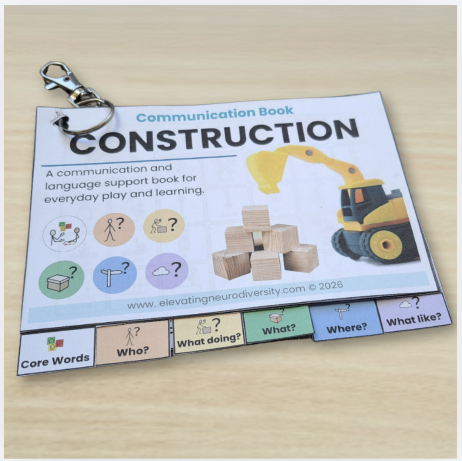
The Shared Communication Books are a practical way to support the Shared Communication Framework during everyday play and learning. They give adults visual support for modelling language while also giving children the opportunity to use the same symbols if they choose.
The books are not designed to test a child’s communication or prompt them to find particular symbols. They can simply be used alongside the interaction, with the adult modelling language that fits what is happening.
Some children may point to symbols, combine them with speech or AAC, while others may simply watch as the adult models.
The focus is always the interaction, not the resource.
Evidence-Informed Practice
The Shared Communication Framework brings together ideas from shared attention, responsive interaction, natural language modelling and Colourful Semantics. These approaches all support the idea that communication develops through meaningful interactions rather than only through structured teaching.
The framework encourages adults to notice what matters to the child, follow their interests, model language naturally and respond to communication in whatever form it takes. It also recognises the importance of connecting language to real experiences, giving children a meaningful context in which to hear and use language.
Shared communication begins with shared attention.
This is the foundation of the framework. Before we can build communication together, we need to notice what the child is attending to and join them in that experience.
Further Reading
If you’d like to explore the ideas behind the Shared Communication Framework in more detail, these resources provide useful guidance on supporting communication with autistic children and young people.
NICE: Autism spectrum disorder in under 19s: support and management
NICE guidance includes recommendations around play-based social communication approaches, responsive interaction, modelling and expanding communication.
National Autistic Society: Tips for effective communication with autistic pupils
Practical guidance for education staff on adapting communication, valuing different ways of communicating and using visual supports.
ASHA: Augmentative and Alternative Communication (AAC) Practice Portal
Professional guidance on AAC, including communication books, symbols, gestures and other communication modalities.
Frequently Asked Questions About the Shared Communication Framework
Is the Shared Communication Framework a communication programme?
No. It is a practical framework for helping adults recognise and support communication during everyday interactions. It can be used alongside approaches such as AAC and Colourful Semantics.
Do I need to ask children questions to support communication?
No. Questions can be part of interaction, but they don’t need to be the starting point. The framework encourages adults to notice what the child is doing, join their experience and model language naturally.
What if a child isn't using spoken language?
The framework can support children who communicate in many different ways. Eye gaze, gestures, movements, sounds, actions, AAC and speech can all be meaningful, shared communication.
Should I encourage children to repeat the language I model?
No. The aim of modelling is to provide meaningful language within an interaction, not to require the child to repeat it. A child can listen, watch or respond in their own way.
Can I use the framework with AAC?
Yes. Adults can model language alongside AAC without expecting the child to use the symbols immediately. The focus remains on shared communication rather than performance.
Do I need the Shared Communication Books to use the framework?
No. The framework can be used with or without the books. The books are simply one practical tool for supporting language modelling during everyday experiences.
Can I use the framework at home?
Yes. The framework can be used during everyday play, routines and shared experiences at home as well as in educational settings.
What is the most important thing to remember?
Shared communication begins with shared attention.
Start by noticing what matters to the child, join their experience, model meaningful language, respond to their communication and expand when it feels appropriate.

About the Author
Hi, I’m Alison an autism specialist teacher and Additional Learning Needs Lead Teacher with over 20 years’ experience in education. My work with autistic and neurodivergent learners has shaped the practical approaches I share through Elevating Neurodiversity.