When I first started teaching, I was very aware that I needed to support my pupils to develop their communication, but I did not yet understand the difference between how to model language for autistic children and asking a child to produce language.
It took me time to realise that I was putting the focus on the child producing the word rather than on creating a meaningful reason for communication. The most memorable part came later, when I realised just how much my repeated use of the word “say” had become part of the children’s communication. I had to spend months deliberately modelling language differently before some of them stopped putting “say” in front of the words they wanted to communicate. Believe me when I tell you, undoing that was hard.
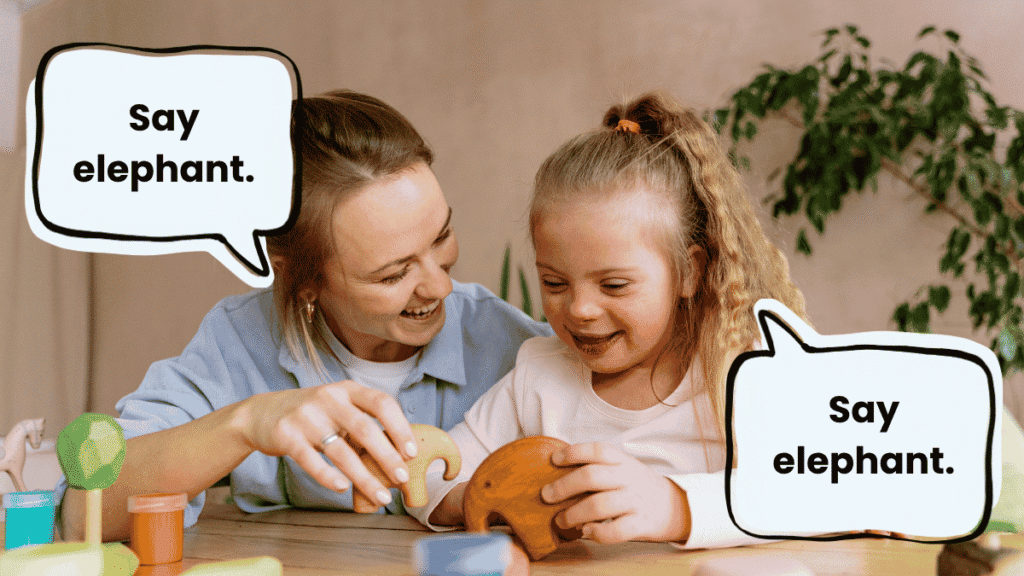
Instead of saying, “Say more,” I began simply modelling, “More.” Instead of saying, “Say car,” I would say, “Car,” or comment, “The car’s going.” I became much more conscious of the language I was giving the children and, just as importantly, the expectations I was placing around it.
That experience completely changed the way I think about language modelling. I realised that if I continually tell a child to “say” something, I may actually be teaching them that communication is something they perform when an adult asks them to. Once I stopped putting that pressure on the interaction and started modelling language within the experiences the children were already having, communication became much more natural.
That distinction is at the heart of how I now use language modelling in my classroom. The aim is not to get a child to repeat our words. It is to give them meaningful language within an experience that already matters to them.
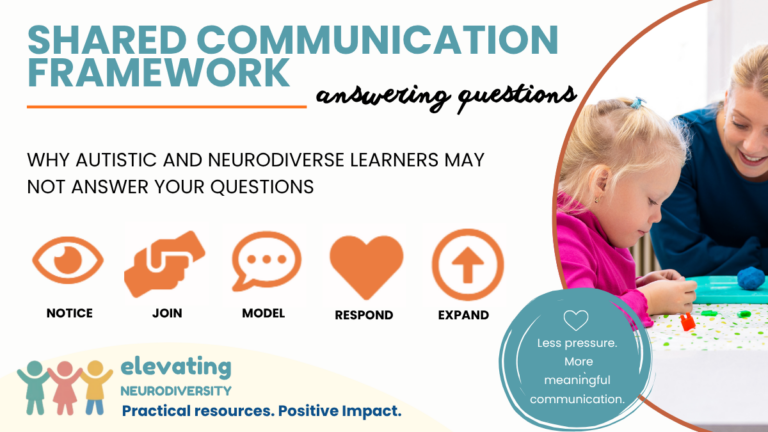
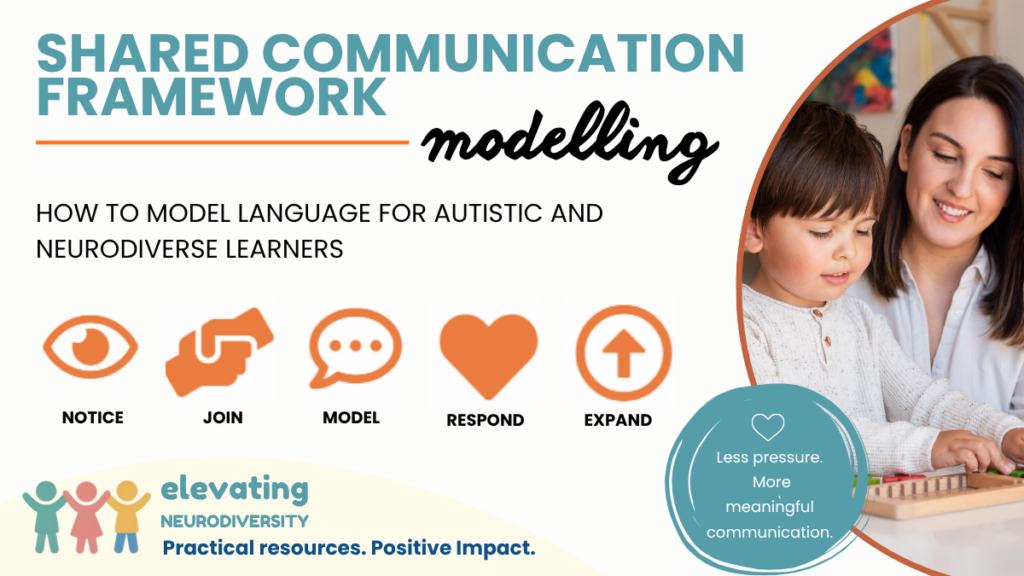
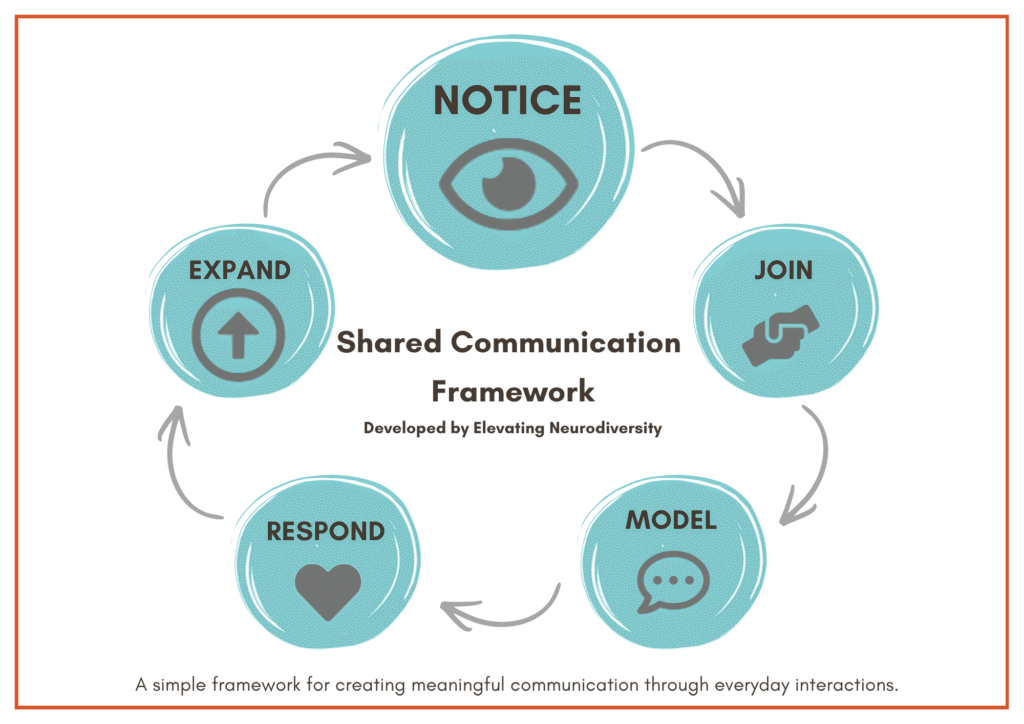
This is the thinking behind the Model stage of my Shared Communication Framework. Rather than beginning with what we want a learner to say, we begin with what they are doing, noticing or interested in, and model language that belongs naturally within that experience.
What Does It Mean to Model Language for Autistic Children?
Language modelling means providing language for a child to hear and potentially use within meaningful interactions. We might notice then comment on what they are doing, describe something that is happening, model a useful word or phrase, or expand by adding a little more language to something they have already communicated.
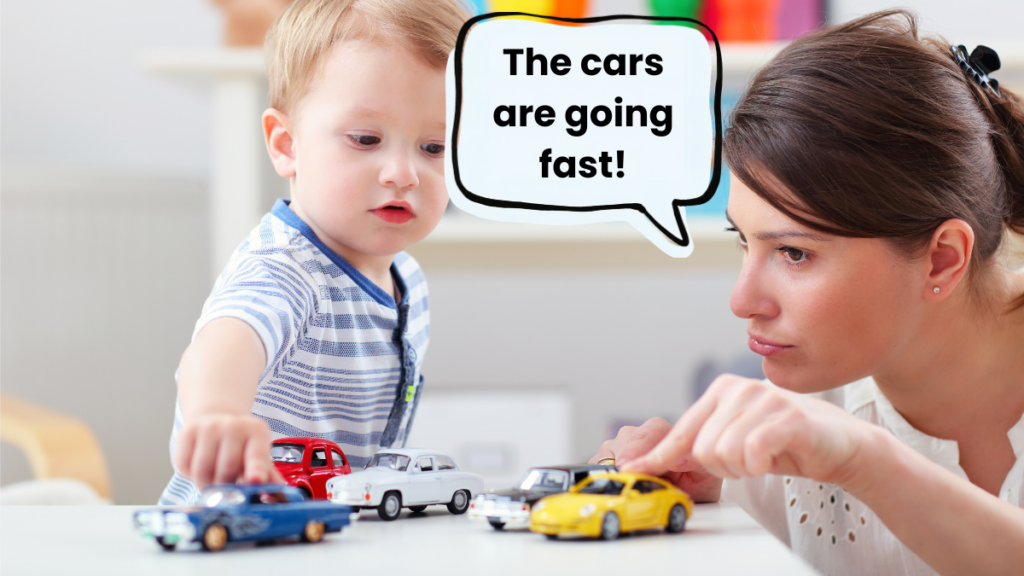
The context matters. If a child is pushing a car along the floor, I could hold up a picture of a car and say, “Car. Say car.” Alternatively, I could sit beside them, push another car and say, “The car’s going fast.” Both approaches contain the word car, but the second gives the language a clear connection to what the child is experiencing.
The child does not need to repeat “car” for the modelling to have been worthwhile. They are hearing the word while they are looking at, touching and moving a car, which gives the language meaning. This is why I think it is helpful to see modelling as giving language to the moment, rather than asking a child to demonstrate whether they know a particular word.
Start with what the learner is doing
One of the simplest ways to model language is to notice what the child is doing, then join alongside and model language about what is happening rather than immediately asking the learner to tell you about it. If a child is painting, I might say, “You’re painting,” or “You’re painting a big circle.” If a learner is building, I might say, “You’re building a tower.” If they are jumping, I might say, “You’re jumping up and down.”
The language does not need to be complicated. In fact, simple language is often more useful because it stays closely connected to what the learner can see, hear, touch and do.
This also gives us an opportunity to think about how many questions we naturally ask throughout the school day. Teachers ask questions for lots of good reasons, but sometimes we can become so focused on finding out what a child knows that we forget to give them language simply to listen to and experience.
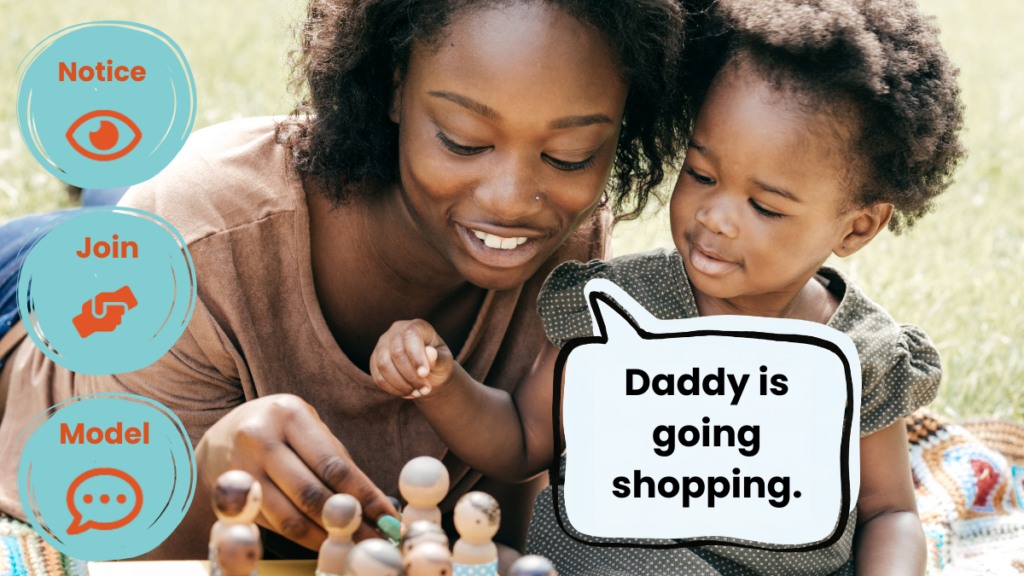
Imagine a child playing with a doll set. We could ask, “Who’s that?”, “What Mummy doing?” and “Where is Daddy going?” Or we could sit alongside them and say, “Daddy is going shopping.” The latter gives the learner language that belongs to their play without requiring them to stop what they are doing and produce an answer.
If they want to respond, there is something meaningful to respond to. If they do not, the interaction can continue.
What modelling looks like in my classroom
In my own classroom, I find that the best opportunities for language modelling are usually already happening. I do not need to create a separate communication activity every time I want to support language because the ordinary experiences of the school day are full of opportunities to model language naturally.
Water play is a good example. If a learner is pouring water into a container, I might say, “You’re pouring.” If they pour the water into a larger bucket, I might model, “You’re pouring the water into the big bucket.” If the water spills, I might comment, “Oh, it’s gone everywhere.” The language changes because the experience changes, which means I can model vocabulary and phrases that are immediately relevant to what the learner is actually doing.
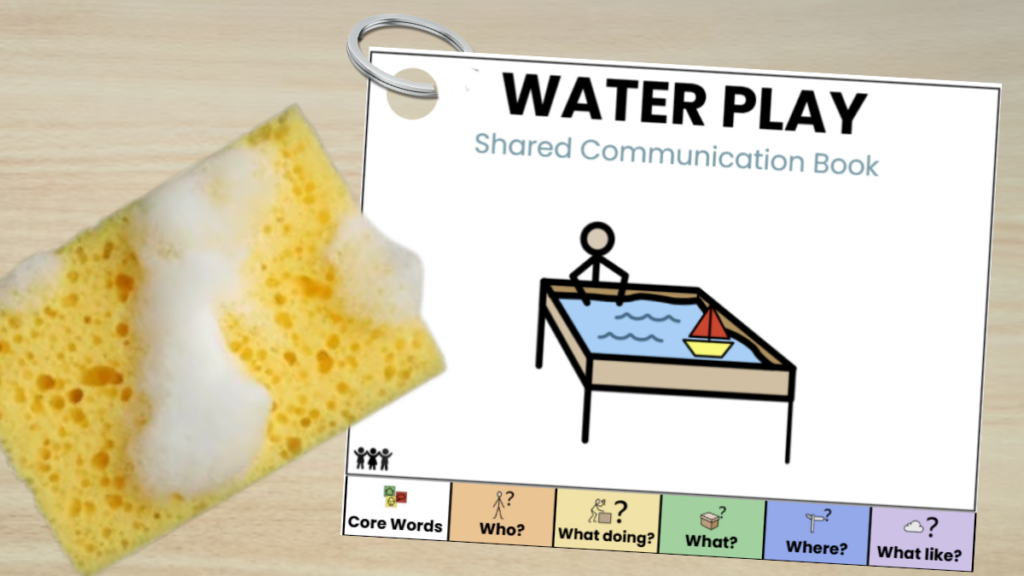
This is also the thinking behind my Shared Communication Books, which I created to support adults to model language during everyday play and routines. The water play book includes symbols that allow you to model “You’re pouring,” “I’m filling the bucket” and “You found the boat! Let’s make it float,” showing how the same activity can create opportunities to Notice, Join, Model, Respond and Expand communication.
I am also paying attention to what the learner is communicating. If they hand me a container, I respond to that. If they move my hand towards something, I respond to that. If they make a sound or gesture, I acknowledge it. The modelling becomes part of a shared interaction rather than something I am delivering to the child.
This is where the stages of the Shared Communication Framework work together naturally. I notice what has captured the learner’s attention, I join their experience and then I have a genuine reason to model language. I am not walking over to a child and deciding that now is the time to practise a particular word. I am using the experience that is already happening as the context for communication.
Model language that gives the learner somewhere to go next
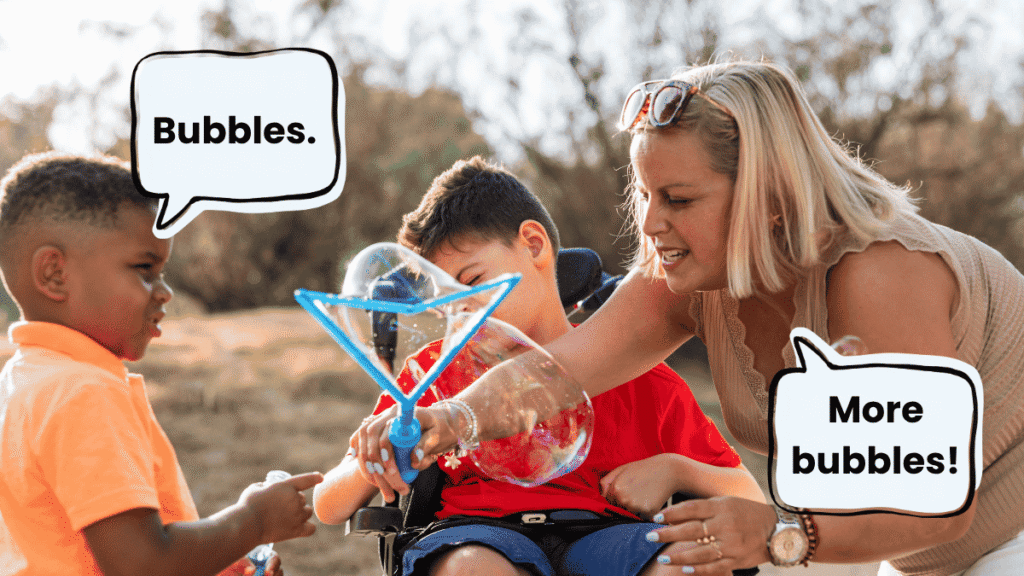
Once we become comfortable with noticing, joining in and commenting on what is happening, we can think about the amount and complexity of language we are modelling. If a learner is using a single word such as “car”, I might model “blue car” or “car go”. If they are using “more”, I might model “more bubbles”. If they are already combining two words, I might occasionally model a slightly longer phrase that fits naturally within the situation.
The important thing is not to turn every communication attempt into an opportunity for correction. If a child says “car” and I respond, “Yes, red car,” I have acknowledged their communication and provided a little more language. I have not told them that “car” was wrong because they should have said “red car”.
The purpose is to give the learner more language to hear and potentially use, rather than making every interaction into a lesson in producing longer sentences. The learner can take up that language when they are ready.
This also means we do not need to expect imitation. If I say, “You’re pouring,” the child might continue pouring, look towards me, make a sound, use a gesture, select something on their AAC system or simply carry on with the activity. I can allow the language to sit within the interaction rather than immediately asking them to repeat it.
What about learners who use AAC?
Language modelling is not limited to spoken language, so the same approach can be used when a learner communicates using AAC, symbols, communication books or another form of supported communication. We can speak while modelling on the learner’s AAC system, use symbols alongside our spoken language and provide models that are relevant to what is actually happening.
For example, if a child is using a communication book during a sensory activity, I might model “more”, “go” or “stop” when those words genuinely fit the experience. I am not necessarily expecting the child to select the symbol immediately. I am showing them how their communication system can be used within a real interaction.
Recent research examining naturalistic interventions for autistic children with minimal speech has also highlighted the potential value of incorporating aided AAC into these approaches, although the evidence is still developing and has limitations. This supports the importance of giving learners opportunities to experience AAC as part of meaningful communication rather than treating it simply as a tool for producing a requested response.
You don’t need to narrate everything
There is a temptation, once we start thinking about language modelling, to talk constantly. We can become so conscious of needing to provide language that we end up narrating almost everything a child does, but I do not think that is what effective modelling looks like.
Autistic learners need opportunities to attend, process, communicate and simply enjoy an experience without an adult providing a running commentary over everything they do. Good modelling is responsive, which means sometimes I might say one word, sometimes I might use a short phrase and sometimes I might make a comment and then leave some space for the learner to continue the interaction.
The aim is not to increase the amount of adult talking for its own sake. It is to increase the amount of meaningful language connected to experiences that matter. I would much rather see a teacher model a few relevant words or phrases during a genuinely shared activity than spend five minutes deliberately teaching vocabulary that has little connection to what the learner is doing.
What if the child doesn’t respond to my modelling?
One of the most important things I have learned is that we do not need to measure the success of modelling by whether the child immediately responds.
If I say, “You’re building a tower,” and the child does not look at me, repeat “tower” or otherwise respond, that does not mean the interaction has failed. They may have heard me, they may be processing the language, they may be communicating in another way, or they may simply be completely absorbed in what they are doing.
We do not need to immediately repeat ourselves, prompt them to copy us or ask, “What did I say?” The model can simply become part of the shared experience, and we can remain available to respond when the learner communicates in their own way.
This is an important part of reducing pressure around communication. Our success does not depend on the child producing the response we were hoping to hear. We can provide useful language, give the learner opportunities to experience it and remain open to whatever communication comes next.
Want to put the Shared Communication Framework into practice?
The Shared Communication Framework brings together five stages, Notice, Join, Model, Respond and Expand, to help adults create meaningful communication during everyday play, routines and learning experiences.
You can download my free practical guide to start using the framework in your own classroom.
Final thoughts
Modelling language does not need to mean asking a child to repeat after us, correcting their communication or filling every moment with adult language. When we model language within an experience that already has meaning, we give learners language that is connected to what they are doing, interested in and experiencing, which provides a much more meaningful foundation from which to develop their own communication.
For autistic and neurodivergent learners, this can make communication feel less like a performance and more like part of being understood. It also changes our role as adults because we are no longer simply trying to get a child to produce the words we have decided they need. Instead, we are becoming communication partners who pay attention to what matters to the learner and use those shared experiences as opportunities to model useful language.
That is what the Model stage of the Shared Communication Framework means to me. We start with what the learner is doing, join the experience and then give language to the moment, without making the learner’s ability to repeat us the measure of whether communication has been successful.
Start with what the learner is doing. Join the experience. Then give language to the moment.
Alison Garza – Specialist Teacher