Teaching WHO in Colourful Semantics begins with helping learners notice the person, people or character involved in a message. The orange WHO layer is often an early part of the pathway I introduce, before learners begin combining this information with actions, objects and locations.
In my specialist classroom, I do not begin by asking every learner to identify unfamiliar people from picture cards. I may start with photographs of familiar adults and children, highly meaningful characters or other people the learner already recognises. The aim is to make the idea of WHO meaningful before expecting the learner to use it within a longer sentence.
I also do not expect a learner to completely master WHO before encountering the next Colourful Semantics layer. Some learners benefit from focusing closely on one element, while others begin making connections between WHO and WHAT DOING through real actions and everyday experiences.
In this guide, I will share how I introduce and teach the WHO layer, how I adapt the visual support for different learners, and how I begin connecting WHO with the wider Colourful Semantics pathway.
Understanding the WHO Layer in Colourful Semantics
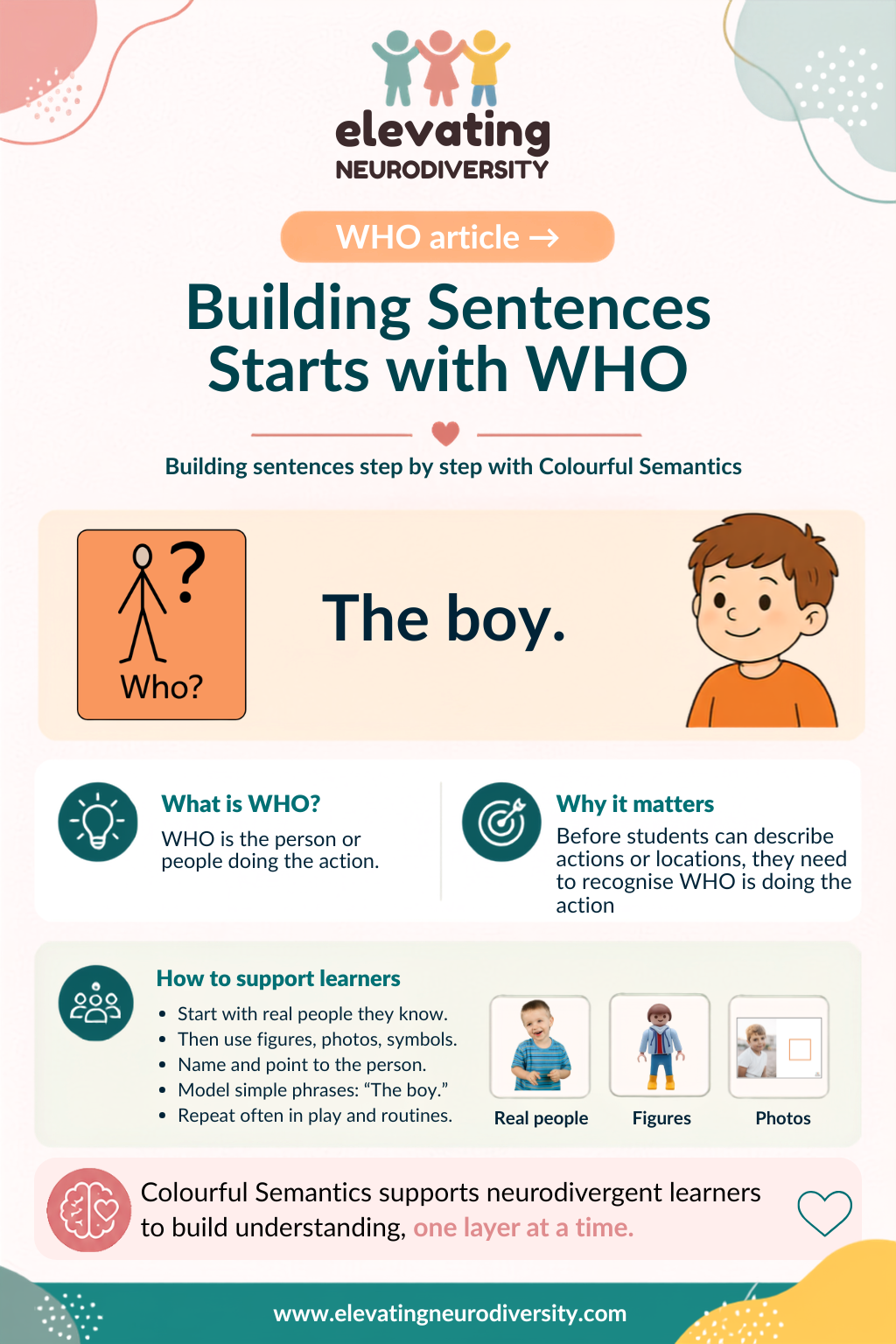
In Colourful Semantics, the orange WHO layer focuses on the person, people or character involved in the message. It answers the question:
WHO is involved?
For some learners, I begin by exploring WHO separately so that they can focus on this part of the message without needing to process a complete sentence at the same time. This might involve matching photographs of familiar people, choosing between two meaningful characters or identifying who is involved in a real activity.
I do not begin by teaching grammatical terms such as subject. Instead, I use the consistent WHO question and orange colour coding to make this part of the message more visible.
As the learner begins to understand the role of WHO, I can connect it with other parts of the Colourful Semantics pathway. A familiar person or character can begin to do something, allowing WHO and WHAT DOING to come together naturally.
Why Identifying WHO Can Be Challenging for Some Learners
Identifying WHO may appear straightforward, but the task can involve more than simply recognising a person or character in a picture. A learner needs to understand what the question is asking them to notice and identify which person, people or character are relevant to the message.
The visual material itself can also affect the task. A familiar photograph may be immediately meaningful to one learner, while an unfamiliar illustration or symbol may be difficult to interpret. In a busy scene, there may be several people present, making it less clear who is important to the action or message.
For some learners, the WHO question may also be easier to understand when it is connected to something happening. A photograph of a familiar adult standing alone may provide little context, whereas seeing that person jumping, cooking or reading can make their role within the message more meaningful.
This is why I look beyond whether a learner can correctly select a WHO card. I consider whether they recognise the person or character, understand the visual representation and are beginning to notice who is involved within a meaningful context.
Preparing to Teach the WHO Layer
Before I begin a structured WHO activity, I think about what the learner already recognises and how they are most likely to understand the people or characters I present.
For some learners, photographs of familiar adults, family members or classmates may be the clearest starting point. Others may respond more readily to favourite characters, familiar illustrations or symbols they already use. I choose the visual representation according to the learner rather than assuming that one type of image will work for everyone.
I also consider how much information is presented at one time. A learner may initially benefit from choosing between two clearly different people or characters, while another may be ready to identify WHO from a wider range of options or within a more complex scene.
The orange WHO colour can provide a consistent visual reference, but the colour itself does not teach the concept. I use it alongside meaningful examples and the repeated WHO question so that the learner can begin to connect the visual cue with the idea of noticing who is involved.
Preparing to teach WHO is therefore less about creating a particular set of cards and more about choosing examples, visuals and a level of support that give the individual learner the best opportunity to understand what the question is asking.
Ready to Start Using Colourful Semantics?
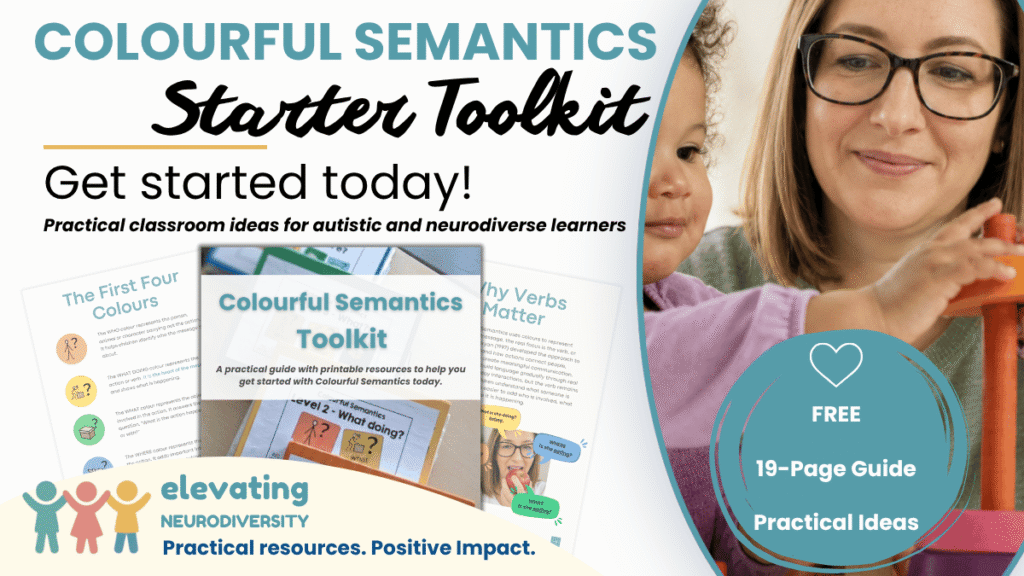
If you’re ready to introduce Colourful Semantics in your classroom, download my free Colourful Semantics Starter Pack. It includes practical classroom resources, printable visual supports and guidance to help you begin with confidence.
Teaching WHO Through Familiar People and Meaningful Experiences
When I introduce the WHO layer, I look for opportunities to connect it with people, characters and experiences that already have meaning for the learner.
This might involve noticing who is taking part in a familiar classroom activity, looking at photographs from something the learner has experienced or using a favourite character within play or shared learning. Rather than teaching WHO only through isolated picture cards, I want learners to encounter the idea of who is involved across different contexts.
Real actions can be particularly useful. If a familiar adult is cooking, a classmate is playing or a favourite character is jumping, the learner can begin to notice WHO within something that is actually happening. This can also create a natural connection with the yellow WHAT DOING layer without requiring WHO to be completely mastered first.
Fictional characters can also provide meaningful WHO examples when they are relevant to the learner or the wider learning context. The important consideration is not whether one category is universally easier than another, but whether the learner recognises who or what is involved and can begin to understand their role within the message.
Animals can be identified as WHO when they are portrayed as participants in a human-like action or situation. For example, a dog surfing, wearing sunglasses or cooking can be treated as WHO because the animal is being anthropomorphised within the context of the image, story or activity. The key is to consider the meaning of the event rather than automatically treating every animal as WHO simply because it appears in the picture.
Over time, I vary the examples and contexts so that understanding does not become tied to one set of familiar photographs or practised cards. WHO can be explored through everyday experiences, photographs, stories, play, curriculum learning and visual resources, while the orange colour and WHO question provide a consistent point of reference.
What Teaching the WHO Layer Looks Like in My Classroom
In my specialist classroom, teaching WHO does not always look like a learner sitting at a table completing a sentence-building activity. I look for opportunities to draw attention to who is involved during experiences that are already happening throughout the day.
I might use photographs taken during a familiar classroom activity and revisit them with the learner afterwards. We can look at who was involved before noticing what that person was doing. For another learner, I may use a highly meaningful character within an activity because that gives them a clear and motivating person or character to notice.
I also model the WHO question without always expecting an immediate answer. During shared activities, stories or play, I can draw attention to a familiar person or character, use the orange WHO cue and model the answer. This allows the learner to encounter the structure without every interaction becoming a test.
As learners become more familiar with WHO, I use the same underlying idea across different parts of the curriculum. We might identify who is involved in a photograph, a story, an illustration or something that has happened in school. The activity can change while the orange WHO cue and the question “Who is involved?” remain familiar.
What this looks like will vary considerably between learners. One learner may be choosing between two photographs of familiar people, while another may be identifying several characters within a story or using WHO as part of a longer sentence. I use the same framework at different levels rather than expecting every learner to complete the same activity.
Recognising Different Ways of Responding
Understanding the WHO layer does not need to be demonstrated through spoken language. Learners can show what they understand in different ways, and I adapt the activity so that the method of responding does not become an unnecessary barrier.
A learner might point to a photograph, select or hand over a symbol, use eye gaze, arrange visual elements, use AAC, say a word or combine several forms of communication. The important question is whether the learner is identifying who is involved, not whether they can give the answer in one particular way.
I also consider whether the learner already has an established communication system and how the Colourful Semantics activity can work alongside it. The orange WHO prompt can provide additional visual structure, but it should not replace the learner’s existing ways of communicating.
By recognising different forms of response, I can focus more clearly on the concept I am actually teaching: understanding and identifying WHO within the message.
A Note About Gestalt Language Processors
Some learners may process and develop language in ways that do not fit neatly within a word-by-word sentence-building pathway. For learners described as gestalt language processors, breaking language into individual elements such as WHO and WHAT DOING may not reflect how they naturally acquire or use language.
I would therefore not assume that every learner needs to build language by progressing through isolated Colourful Semantics layers. If I use Colourful Semantics with a learner who communicates through gestalts or longer chunks of language, I consider whether the visual structure is genuinely supporting their understanding and communication rather than expecting them to follow a predetermined sequence.
Colourful Semantics can be one tool within a wider communication approach, but it should not replace the learner’s existing communication system, meaningful interaction or individualised support from relevant professionals. As learners move into the later stages of Natural Language Acquisition and begin generating more flexible, self-generated language, Colourful Semantics may become a useful visual support.
How to Support Learners Who Are Finding the WHO Layer Difficult
If a learner is finding the WHO layer difficult, I first look at what the activity is asking them to process. The difficulty may not be with the idea of WHO itself. The person or character may be unfamiliar, the image may be difficult to interpret, there may be too many choices, or the learner may not yet understand what the WHO question is asking them to notice.
I may return to familiar people, meaningful characters or photographs from real experiences and reduce the number of choices presented at one time. I can also model the WHO question without immediately expecting a response, drawing attention to who is involved across everyday activities and shared experiences.
I consider whether the learner understands the visual representation I am using. A photograph, symbol or illustration that seems clear to me may not be meaningful to the learner. Changing the type of visual, simplifying the image or using a real person within an activity may make the concept more accessible.
If identifying WHO in isolation is not meaningful for the learner, I may connect the person or character with an action. Seeing a familiar adult jumping, eating or reading can sometimes provide a clearer context for understanding who is involved than repeatedly asking the learner to identify a static picture.
Most importantly, I do not respond to difficulty by simply repeating the same activity more often. I change the context, the visual support, the number of choices or the way I am presenting the concept and look closely at what helps the learner make sense of WHO.
Evidence-Informed Practice
Colourful Semantics was developed by speech and language therapist Alison Bryan and described in her 1997 chapter, Colourful Semantics: Thematic Role Therapy. The approach uses colour coding to make different thematic roles within a sentence more explicit. Within the pathway I use, the orange WHO layer draws attention to the person, people or character involved in the message.
A later clinical investigation by Bolderson, Dosanjh, Milligan, Pring and Chiat (2011) explored the use of Colourful Semantics with six children aged five and six who had language difficulties. The researchers reported encouraging changes in sentence production, but the study involved a very small group and did not specifically investigate autistic learners or the WHO layer in isolation.
For this reason, I do not assume that teaching WHO through Colourful Semantics will work in the same way for every learner. I use the framework alongside ongoing observation of the individual learner, adapting the people and characters, visual representation, context and level of support according to what helps them understand and communicate.
The evidence base for Colourful Semantics remains limited, so I see the orange WHO structure as a teaching tool rather than a guaranteed intervention. What matters in my classroom is whether it is helping the individual learner notice and communicate who is involved in a meaningful way.
Further Reading
Bryan, A. (1997). Colourful semantics: Thematic role therapy. In S. Chiat, J. Law and J. Marshall (Eds.), Language Disorders in Children and Adults: Psycholinguistic Approaches to Therapy (pp. 143–161). London: Whurr.
Bolderson, S., Dosanjh, C., Milligan, C., Pring, T. and Chiat, S. (2011). Colourful semantics: A clinical investigation. Child Language Teaching and Therapy, 27(3), 344–353.
What Comes After the WHO Layer?
As learners begin to understand WHO, I look for natural opportunities to connect the person, people or character with an action. This introduces the yellow WHAT DOING layer and begins to bring different parts of the message together.
A learner does not need to completely master WHO before encountering WHAT DOING. In fact, for some learners, seeing a familiar person or character doing something can make both elements more meaningful. A photograph of a familiar adult jumping, for example, provides an opportunity to notice both who is involved and what they are doing.
The amount of support will vary. One learner may continue to need a clear orange WHO prompt while beginning to explore actions, while another may be ready to combine WHO and WHAT DOING within a short sentence or visual structure.
As the pathway develops, further information can be added through the green WHAT and blue WHERE layers. I introduce these connections according to the learner rather than treating progression as a fixed sequence that must be completed at the same pace by everyone.
My guide to teaching WHAT DOING in Colourful Semantics explores how I introduce the action layer through real movement, everyday experiences and meaningful contexts.
Explore the WHO Colourful Semantics Resource
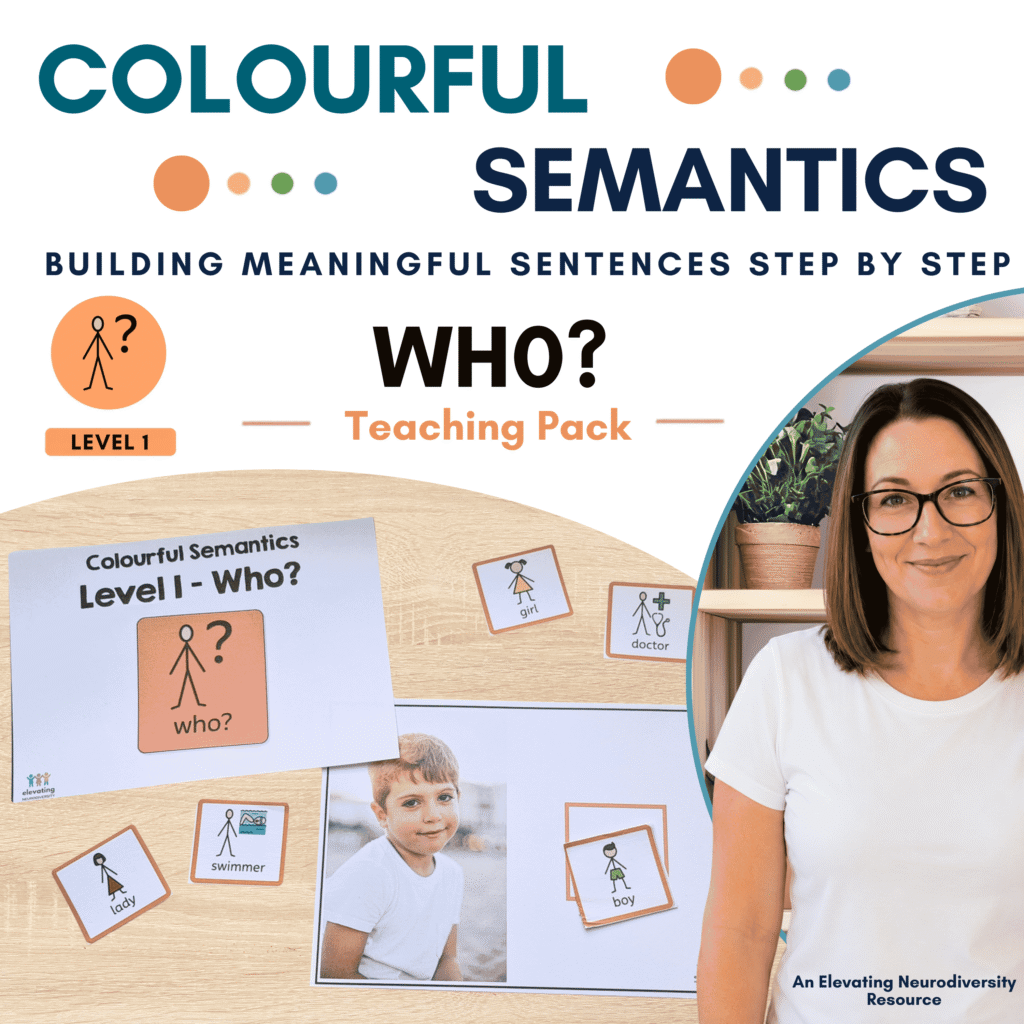
If you are looking for structured visual activities to support the WHO layer, you can explore my Colourful Semantics WHO resource alongside the teaching approach in this guide.
The activities provide opportunities to practise identifying who is involved using visual support, while allowing you to adapt the level of choice and support according to the individual learner.
Final Thoughts
Teaching WHO in Colourful Semantics can provide a useful starting point for helping learners notice who is involved in a message, but meaningful teaching involves more than asking a learner to identify a person or character from a set of cards.
In my specialist classroom, I begin with what the learner already recognises and understands. I use familiar people, meaningful characters, real experiences and carefully chosen visual support, adapting the activity and ways of responding according to the individual learner.
The aim is for WHO to become meaningful beyond a structured activity. As learners begin to notice who is involved across experiences, photographs, stories and wider learning, the orange WHO cue can provide a familiar structure for organising this part of the message.
From there, WHO can connect naturally with actions and the wider Colourful Semantics pathway, supporting learners to communicate increasingly detailed and meaningful messages.