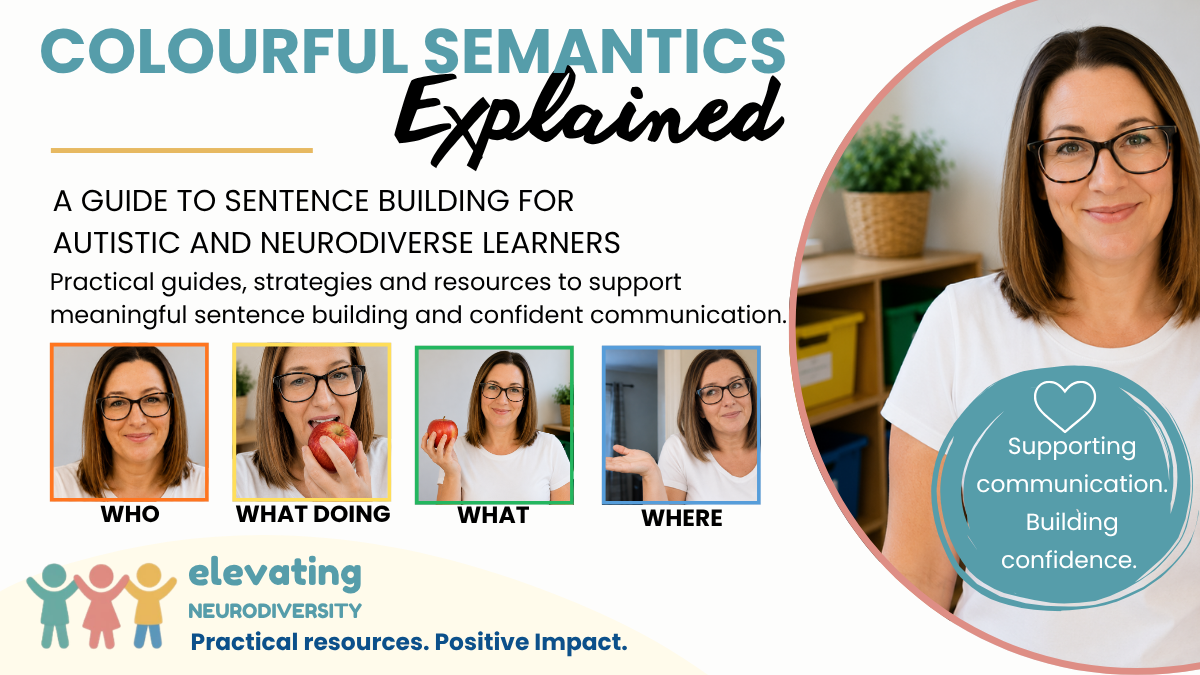
After many years of using Colourful Semantics with autistic and neurodiverse learners, I have found it to be a useful framework for helping learners notice, organise and combine different parts of a sentence.
For some learners, being asked to “say a sentence” can involve managing several pieces of information at once. Who is involved? What are they doing? What is involved in the action? Where is it happening? Colourful Semantics makes these different roles more visible by using colour-coded questions and visual supports.
In my specialist classroom, I use Colourful Semantics as a flexible teaching framework rather than a sequence of worksheets to complete. Some learners need to spend considerable time exploring one part of a sentence through real experiences and meaningful activities. Others are ready to combine several layers or use the visual structure to organise more complex ideas.
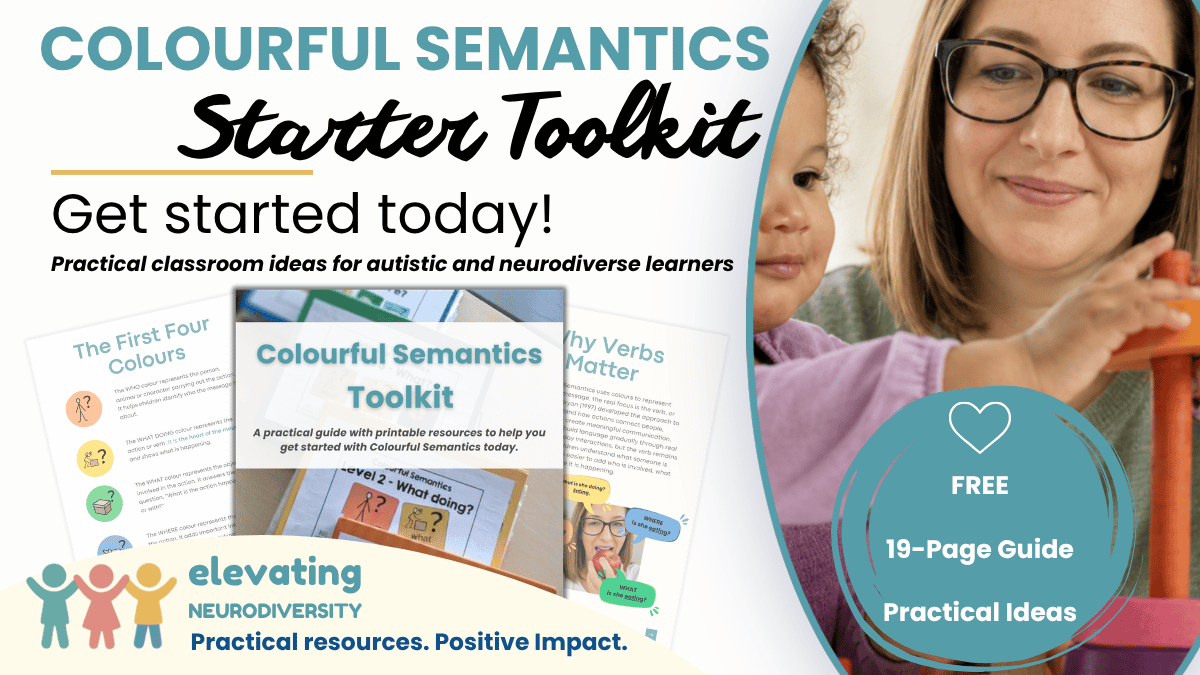
In this guide, I will explain what Colourful Semantics is, explore the core WHO, WHAT DOING, WHAT and WHERE pathway, and share how I adapt the approach for autistic and neurodiverse learners in my own classroom. You can also explore all of my Colourful Semantics teaching guides and classroom resources in one place.
What Is Colourful Semantics?
Colourful Semantics is a visual approach to supporting sentence building and language development. Originally developed by speech and language therapist Alison Bryan (1997), it uses colour-coded questions to help learners identify and organise different parts of a sentence.
Rather than presenting a complete sentence as one large language task, Colourful Semantics makes individual sentence roles more visible. A learner might begin by identifying WHO is involved before adding WHAT they are DOING, WHAT is involved in the action and WHERE the action is happening.
Each part of the sentence is associated with a guiding question and colour. In the core pathway I use, WHO is orange, WHAT DOING is yellow, WHAT is green and WHERE is blue. These are the original Colourful Semantic colours.
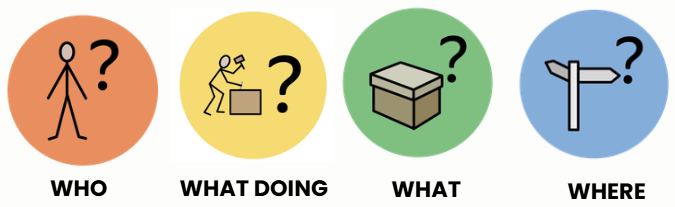
These visual cues can provide a consistent reference point as learners begin to combine information and build increasingly detailed sentences.
Colourful Semantics can be used in different ways depending on the learner. Some may point to or select pictures, symbols or words, while others may use the framework to support spoken language or writing. The aim is not simply to complete a colour-coded sentence strip. The visual structure is there to help learners notice how different pieces of information work together to create meaning.
How Colourful Semantics Organises Sentence Meaning
When we listen to or produce a sentence, we are bringing together different pieces of information. We may need to identify who is involved, what is happening, what is involved in the action and where it is taking place. For some learners, managing all of this information at once can be difficult.
Colourful Semantics separates these elements so that they can be explored individually before being combined. Instead of beginning with the expectation that a learner will produce a complete sentence, I can focus on the part that needs attention. A learner may be confident identifying WHO but need more support to notice the action, or they may build a clear WHO + WHAT DOING + WHAT sentence but not yet recognise location as useful information to include.
This is one of the reasons I find the framework useful in my own teaching. The colours do more than provide a visual sequence. They help me look closely at which part of the message a learner understands and where additional teaching may be needed.
As learners develop their understanding, the individual elements can be brought together. The aim is not to create longer sentences for the sake of length, but to help learners organise and communicate the information that is meaningful to the message.
The Core Colourful Semantics Pathway
The core Colourful Semantics pathway I use develops gradually from identifying who is involved to adding information about the action, object and location. Although the colours provide a clear structure, I do not treat progression as a race through the levels. Learners may need different amounts of time and support at each stage.
WHO? Who Is Involved?
The orange WHO layer focuses on the person, people or character involved in the action. For some learners, I begin with familiar people, photographs or highly meaningful characters before moving towards a wider range of images.
WHO provides an important starting point for sentence building, but I do not expect a learner to completely master one layer before they encounter the next. The pathway can remain flexible according to the learner’s language and communication needs.
My guide to teaching WHO in Colourful Semantics explores how I introduce this first layer through meaningful people and experiences.
WHAT DOING? What Is Happening?
The yellow WHAT DOING layer introduces the action. Combining WHO and WHAT DOING allows learners to begin connecting a person or character with what they are doing, such as “The boy is running” or “The dog is sleeping.”
In my teaching, I use real actions, movement and everyday routines before expecting learners to identify verbs from pictures alone. This helps connect action language with something the learner can see, experience or do.
My guide to teaching WHAT DOING in Colourful Semantics explores this stage in more detail.
WHAT? What Is Involved in the Action?
The green WHAT layer adds information about the object involved in the action. A sentence such as “The girl is eating” might become “The girl is eating an apple.”
This stage is not simply about naming objects. The learner is beginning to connect the object with the action and understand its role within the wider message.
My guide to teaching WHAT in Colourful Semantics explains how I develop this connection before expecting learners to build longer sentences.
WHERE? Where Is the Action Happening?
The blue WHERE layer adds information about place or location. “The girl is eating an apple” might become “The girl is eating an apple in the kitchen.”
I begin with familiar places and real experiences, helping learners notice where everyday actions happen before moving into more structured sentence-building activities. The aim is not simply to name locations, but to recognise when information about place adds useful context to the message.
My guide to teaching WHERE in Colourful Semantics explores how I teach this layer through familiar locations, meaningful experiences and structured visual support.
Why Visual Structure Can Support Sentence Building
For some learners, producing a sentence involves managing several pieces of information at once. They may need to think about who is involved, what is happening and which additional details are important to the message, while also finding and organising the language they want to use.
The visual structure of Colourful Semantics can make these different parts of a sentence more explicit. Instead of relying only on spoken instructions or asking a learner to “make a sentence,” the colours and guiding questions provide visible prompts that can remain available while the learner processes and organises the information.
In my classroom, I find this particularly useful because the visual support does not disappear as soon as I have spoken. A learner can look back at the coloured prompts, photographs, symbols or words and use them as a reference while building their message. For some learners, this can reduce the amount of information they need to hold in mind at one time.
However, visual support is not automatically helpful simply because a learner is autistic or neurodivergent. The amount and type of support need to be considered carefully. A busy board containing too many symbols may increase the demands of an activity, while another learner may need more visual information to understand what is expected.
For me, the value of Colourful Semantics lies in its flexibility. I can make one part of a sentence more visible, reduce the number of choices, use photographs or symbols that are meaningful to the learner, and adjust the support as their understanding develops.
How I Use Colourful Semantics in My Specialist Classroom
In my specialist classroom, I use Colourful Semantics in different ways depending on the learner, the language we are working on and the wider purpose of the activity. It is not something I use only during a designated sentence-building lesson.
For learners who are beginning to explore the individual layers, teaching may involve real actions, familiar people, meaningful places, photographs and carefully chosen visual supports. I might focus on one part of a message or combine several layers, depending on what the learner already understands and what I want to teach next.
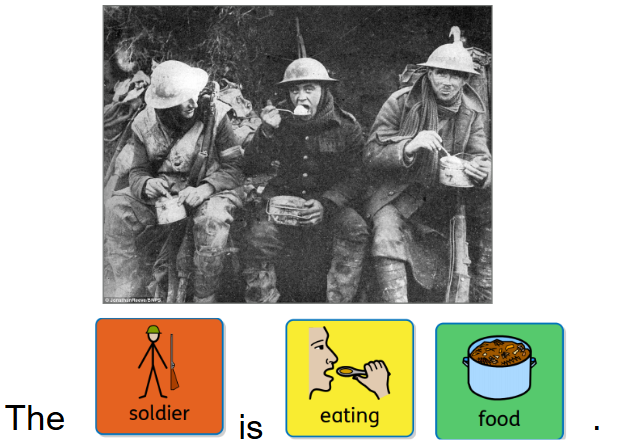
I also use Colourful Semantics within wider curriculum learning. During a Second World War topic, for example, I used the visual structure to support an autistic learner with a cloze procedure activity. The colours helped organise the different parts of the sentence while the learner focused on the historical content.
With another neurodivergent learner, I used the Colourful Semantics colours to create a mind map for organising information about Oliver Twist. At this stage, the framework was not being used simply to build an early sentence from picture cards. The familiar colour coding provided a structure for organising and connecting ideas within a more complex literacy task.
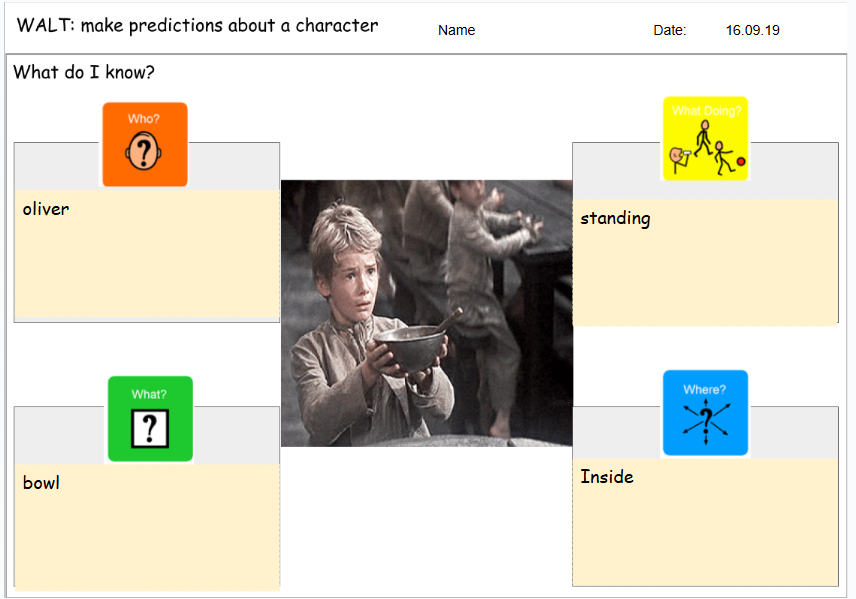
These examples reflect how I think about Colourful Semantics in practice. I do not see it as a fixed programme that must always look the same. The core visual structure can remain familiar while the activity, level of support and purpose change according to the learner.
Adapting Colourful Semantics for Different Learners
Colourful Semantics does not need to look the same for every learner. In my classroom, I adapt the visual support, language demands and type of activity according to what is meaningful and accessible for the individual.
Some learners may benefit from photographs of familiar people, actions and places, while others understand symbols or illustrations easily. I choose visuals based on the learner rather than assuming that one type of image will always be more effective. I also consider how much information is presented at one time, as a large number of symbols or choices can make an activity harder to navigate for some learners.
Learners can respond in different ways. One learner may speak a sentence, while another may point, select a symbol, use AAC, arrange visual elements or combine several forms of communication. I do not treat spoken language as the only successful outcome of a Colourful Semantics activity.
The level of support can also change. A learner may initially need individual colour prompts and a small number of carefully selected choices, then later use the same structure with greater independence. Another learner may continue to find the colour coding useful over time, including for more complex literacy and curriculum tasks.
The aim is not to move every learner through an identical sequence or remove visual support as quickly as possible. I use the framework flexibly, adjusting it to support the learner’s understanding, communication and participation.
Moving Beyond Structured Sentence-Building Activities
Structured activities can provide useful opportunities to introduce and practise different parts of a sentence, but I do not want learners to use Colourful Semantics only when a set of cards or a sentence strip is placed in front of them.
As understanding develops, I look for opportunities to use the same visual structure in different contexts. This might include talking about something that has happened, describing a photograph, supporting writing, exploring a story or organising information within a curriculum topic.

I also vary the people, actions, objects and places learners encounter so that sentence building does not become tied to a small set of practised examples. A learner may be able to build a familiar sentence during a structured activity but still need support to use the same underlying structure when the context changes.
For some learners, visual prompts can gradually be reduced. Others may continue to use the colours as a helpful way to organise language and ideas. I do not see removing the visual support as the goal in itself. What matters is whether the learner can use the structure in ways that support meaningful communication, learning and participation.
Evidence-Informed Practice
Colourful Semantics was developed by speech and language therapist Alison Bryan and described in her 1997 chapter, Colourful Semantics: Thematic Role Therapy. The original approach used colour coding to make the thematic roles within sentences more explicit and support sentence construction.
A later clinical investigation by Bolderson, Dosanjh, Milligan, Pring and Chiat (2011) explored the use of Colourful Semantics with six children aged five and six who had language difficulties. The children received the intervention in clinical practice, and the researchers examined changes in their sentence production. The findings were encouraging, but the study involved a very small group, so it should not be treated as evidence that the approach will produce the same outcomes for every learner.
For me, this evidence supports using Colourful Semantics as a structured framework that can be adapted thoughtfully rather than as a fixed programme with guaranteed outcomes. I combine the visual structure with ongoing observation of the individual learner, meaningful contexts and adjustments to the level and type of support provided.
The research base is more limited than the widespread use of Colourful Semantics in education and speech and language practice might suggest. This is why I avoid describing it as a universally effective approach for autistic or neurodiverse learners. Instead, I consider whether the framework is helping the individual learner understand, organise and communicate language more effectively.
Further Reading
Bryan, A. (1997). Colourful semantics: Thematic role therapy. In S. Chiat, J. Law and J. Marshall (Eds.), Language Disorders in Children and Adults: Psycholinguistic Approaches to Therapy (pp. 143–161). London: Whurr.
Bolderson, S., Dosanjh, C., Milligan, C., Pring, T. and Chiat, S. (2011). Colourful semantics: A clinical investigation. Child Language Teaching and Therapy, 27(3), 344–353.
Explore the Colourful Semantics Teaching Guides
If you are looking for more detailed guidance on teaching each part of the Colourful Semantics pathway, I have created a series of practical guides based on how I use the approach with autistic and neurodiverse learners in my specialist classroom.
Explore the guides below to focus on the stage that is most relevant to your learner.
Explore Colourful Semantics Classroom Resources
If you are looking for visual resources to support your teaching, you can explore my Colourful Semantics classroom resources alongside the teaching guides.
The resources are designed to support different stages of the WHO, WHAT DOING, WHAT and WHERE pathway, with structured visual activities that can be adapted according to the learner and the purpose of the lesson.
I use these resources as part of a wider teaching approach rather than as a replacement for meaningful experiences, modelling and responsive teaching. The activities provide opportunities for structured practice while the teaching guides explore how I introduce and develop each layer in my own specialist classroom.
Final Thoughts
Colourful Semantics has become a valuable part of how I support sentence building and language organisation in my specialist classroom, but I do not see it as a fixed programme that every learner must follow in the same way.
If you are beginning to use Colourful Semantics, start with what the learner already understands and consider which part of the message needs support. For one learner, that may mean exploring WHO through familiar people and photographs. For another, it may mean using the same colour structure to organise a longer sentence, a piece of writing or ideas within a curriculum topic.
The colours provide a structure, but thoughtful, responsive teaching is what gives that structure meaning.