After many years of using Colourful Semantics with autistic and neurodiverse learners, I have found that teaching WHERE in Colourful Semantics can be an interesting stage in sentence building. Learners who can confidently identify WHO is involved, WHAT they are DOING and WHAT is involved in the action may still find it difficult to explain where that action is happening.
Teaching the WHERE layer is about helping learners add location and context to their communication. A sentence such as “The boy is kicking the ball” tells us what is happening, but adding “on the playground” gives the listener another important piece of information.
In my classroom, I do not begin by asking learners to build four-part sentences from picture cards. I start with familiar places and everyday experiences before moving into more structured sentence building.
If you are working through the Colourful Semantics layers, you can explore my Colourful Semantics teaching guides and classroom resources in one place.
In this guide, I will share how I teach the WHERE layer in Colourful Semantics, why adding location information can be challenging for some autistic and neurodiverse learners, and the practical strategies I use in my classroom.
What Does the WHERE Layer Mean in Colourful Semantics?
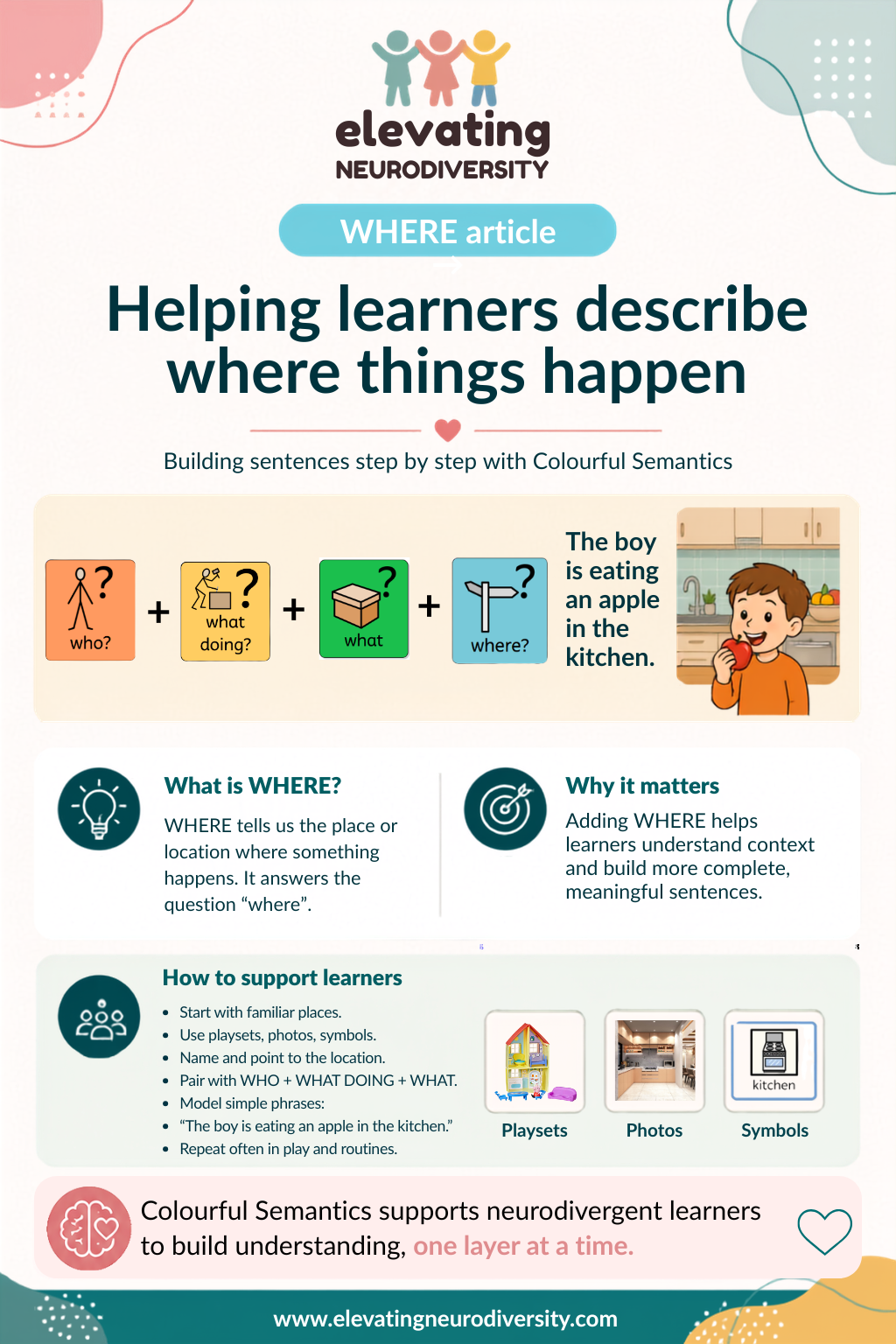
In Colourful Semantics, the blue WHERE layer adds information about place or location. It answers the question “Where?” and helps learners understand where an action is happening. For example, a learner may already be able to build the sentence, “The boy is eating an apple.” Adding the WHERE layer allows them to extend this to, “The boy is eating an apple in the kitchen.” The kitchen tells us where the action is taking place and gives the listener additional context.
The WHERE layer can include familiar places such as the classroom, playground, kitchen, park or swimming pool. However, recognising or naming a place is not quite the same as understanding how it fits within a sentence. A learner may correctly identify a picture of a playground but still need support to communicate that “The girl is running on the playground.”
This distinction is important. The purpose of the WHERE layer is not simply to teach the names of places or make sentences longer. It is to help learners connect an action with the place where it is happening and recognise when location information adds useful meaning to their communication.
Why the WHERE Layer Can Be Challenging for Autistic and Neurodiverse Learners
The WHERE layer can be challenging because recognising a place is not the same as understanding that it is relevant to the message. A learner may confidently identify a classroom, park or swimming pool but focus primarily on the person, action or object when building a sentence. For example, a learner may see a boy kicking a ball in the park and communicate “The boy is kicking the ball.” To them, the message may already feel complete. The location is visible, but it is not yet information they recognise as useful to share.
Some learners also strongly associate particular actions with familiar places. Reading may mean the classroom and eating may mean the dining hall because these reflect their everyday routines. When the same action happens somewhere different, they may need support to notice and communicate the change in location.
There is also a difference between answering a direct WHERE question and adding location information independently. A learner may correctly point to the playground when asked, “Where is the boy running?” but still leave the location out when building the whole sentence.
Preparing to Teach the WHERE Layer
Before I formally introduce the WHERE layer, I consider what the learner already understands. I do not expect complete mastery of WHO, WHAT DOING and WHAT, but I want the learner to be familiar with the earlier layers and able to combine some of this information with support. If building the first parts of a sentence still requires significant effort, adding WHERE may increase the language and cognitive demands of the activity.
If your learner is still developing the earlier sentence structure, my guide to teaching the WHAT layer in Colourful Semantics explores how I introduce objects before adding WHERE.
I also look at the learner’s understanding of familiar places. Can they recognise locations they regularly experience, such as the classroom, playground, toilet, dining hall or home? They do not need to name every location independently, but I want these places to carry some meaning for them.
Finally, I consider whether the learner is beginning to notice that actions happen somewhere. I am not looking for memorised action-and-place combinations. I simply want to see an emerging connection between what is happening and where it is taking place.
These observations help me decide whether to move into structured sentence building or spend more time drawing attention to familiar locations through everyday experiences.
Teaching the WHERE Layer Through Movement and Real Experiences
When I begin teaching the WHERE layer, I use the classroom and wider school environment before introducing structured sentence-building activities. Learners move between different places throughout the day, giving us natural opportunities to draw attention to where actions are happening.
I use everyday routines to model complete messages. If a learner is eating their snack in the classroom, I might say, “Billy is eating an apple in the classroom.” Outside, I might comment that a child is riding a bike on the playground. In the library, I might model, “Amelia is reading a book in the library.”
I am not stopping each activity to repeatedly ask, “Where is Billy eating?” Instead, I include the location naturally while the learner is experiencing the place for themselves. The classroom, playground or library is not an abstract image on a card. It is somewhere they know.
I also deliberately model the same action happening in different places. Eating may happen in the dining hall, classroom or outside during a picnic. Reading might happen in the classroom, library or at home. This helps prevent fixed associations such as reading = classroom or eating = dining hall.
Learners’ interests can also create meaningful opportunities to explore WHERE. If a learner is interested in Bluey, for example, I might use familiar characters in play or photographs and talk about Bluey eating in the kitchen, playing in the garden or swimming at the pool. The focus remains on connecting the action with the place.
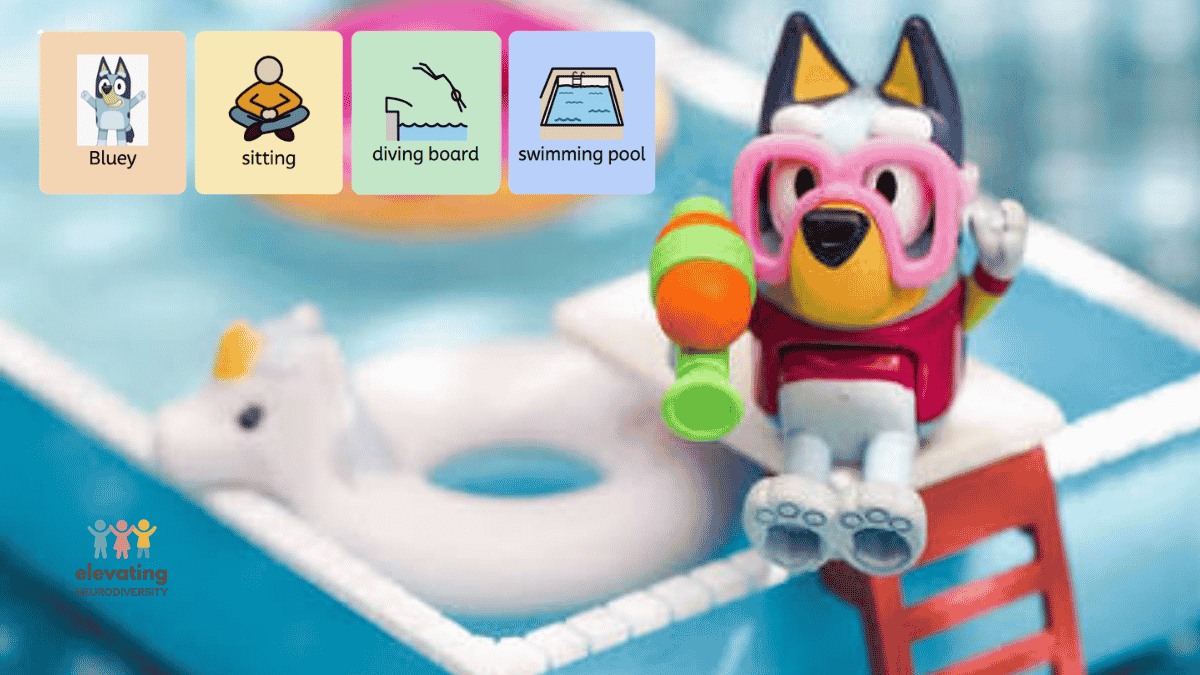
At this stage, I listen carefully and notice whether the learner is beginning to attend to location information. Some learners start adding familiar places to sentences quickly. Others may point towards a location, select a photograph or answer a WHERE question before they are ready to build the complete sentence.
These responses help me decide when to introduce pictures, symbols and more structured Colourful Semantics activities. My aim is not for learners to memorise a list of places. I want them to notice that actions happen somewhere and that where they happen can be important to the message.
When to Introduce Pictures, Symbols and Structured Activities
Once a learner is beginning to notice where actions happen through everyday experiences, I introduce pictures and symbols. At this stage, the visual representation supports an idea the learner has already begun to understand rather than asking them to learn WHERE from an unfamiliar picture alone.
I usually begin with familiar photographs. A photograph of a learner eating in the classroom or playing on the playground can be easier to interpret than an unfamiliar stock image. I use the blue WHERE prompt alongside the photograph and model the complete sentence, drawing attention to where the action is happening.
As understanding develops, I introduce a wider range of images and structured sentence-building activities. This helps me see whether the learner is beginning to understand WHERE more flexibly rather than recalling a familiar classroom sentence.
This is the stage where I use my Level 4 Colourful Semantics WHERE Pack. The visual activities provide structured opportunities to practise adding location information after learners have begun connecting actions with places through real experiences.

I continue to move between structured activities and meaningful contexts. If a learner finds it difficult to identify where an action is happening in a picture, I may connect it to a familiar experience before returning to the activity.
How to Support Learners Who Are Finding the WHERE Layer Difficult
When a learner is finding the WHERE layer difficult, I try to identify exactly where the difficulty lies. A learner who does not recognise a location needs different support from one who knows the place but finds it difficult to include WHERE within a complete sentence.
Sometimes, a learner can name familiar places but does not yet connect the location with the action. In this situation, I return to actions happening in real places and model the complete sentence while the learner experiences what is happening and where.
For other learners, the place itself may be unfamiliar. A picture of a supermarket, café or swimming pool may carry little meaning if the learner has limited experience of that location. I begin with places they already know and gradually widen the range through photographs, shared experiences and classroom learning.
Some learners can answer a WHERE question correctly but leave the location out when building a complete sentence. Here, I consider the overall language demand. Combining WHO, WHAT DOING, WHAT and WHERE requires the learner to organise several pieces of information, so temporarily returning to a shorter sentence structure may reduce this demand.
I also look for fixed action-and-place associations. A learner may confidently communicate “The boy is reading in the library” but struggle when the action or place changes. I deliberately vary the action while keeping the place familiar, then vary the place while keeping the action familiar.
The most useful question I ask myself is not “Why can’t they do WHERE?” but “Which part of WHERE is difficult for this learner?” This helps me adjust my teaching rather than simply providing more of the same activity.
A Note About Gestalt Language Processors
For Gestalt Language Processors, I would be cautious about introducing the WHERE layer simply because they already use longer scripts or gestalts that include places or location language. A learner may use a phrase such as “Let’s go to the park” or “Time for school” without yet being ready to analyse and rebuild that language using individual Colourful Semantics components.
As learners move into the later stages of Natural Language Acquisition and begin generating more flexible, self-generated language, Colourful Semantics may become a useful visual support. At this stage, the blue WHERE layer can help make the place where an action is happening more visible and support learners as they explore how different parts of a sentence work together.
As always, I would consider the learner’s individual language profile and work alongside their speech and language therapist where appropriate. I would not use Colourful Semantics to break down or correct meaningful gestalts simply to fit them into a colour-coded sentence structure.
Evidence-Informed Practice
The evidence base for Colourful Semantics is still relatively small, and I think it is important to be honest about this. A clinical investigation of Colourful Semantics with six children with language difficulties reported improvements in measures of information, grammar and sentence length during the intervention period, although the researchers highlighted the need for larger studies.
The approach uses colour coding to make the meaning and structure of sentences more visible. This fits with wider evidence-informed approaches to sentence-level language intervention that use explicit teaching and visual or metalinguistic supports to help learners notice how sentence structures work.
Research into contextualised language intervention has also explored teaching language targets within meaningful, connected activities. One early efficacy study found gains in sentence- and discourse-level measures following both contextualised and decontextualised intervention, with larger effects reported for the contextualised group.
For me, this supports a balanced approach: making the WHERE layer visible while also connecting location language to familiar places, actions and real experiences.
Further Reading:
Bolderson, S., Dosanjh, C., Milligan, C., Pring, T. & Chiat, S. (2011). Colourful Semantics: A clinical investigation. Child Language Teaching and Therapy, 27(3), 344–353.
Read the Colourful Semantics study
Balthazar, C. H., Ebbels, S. & Zwitserlood, R. (2020). Explicit grammatical intervention for developmental language disorder: Three approaches. Language, Speech, and Hearing Services in Schools, 51(2), 226–246.
Read the explicit grammatical intervention review
Gillam, S. L., Gillam, R. B. & Reece, K. (2012). Language outcomes of contextualized and decontextualized language intervention: Results of an early efficacy study. Language, Speech, and Hearing Services in Schools, 43(3), 276–291.
Read the contextualised language intervention study
What Comes After the WHERE Layer?
Once learners are beginning to combine WHO, WHAT DOING, WHAT and WHERE, I do not automatically introduce another Colourful Semantics layer. Instead, I focus on helping them use the sentence structures they have developed across different people, actions, objects and places.
If action language is still an area of difficulty, my guide to teaching WHAT DOING in Colourful Semantics shares how I teach verbs through meaningful actions and everyday experiences.
This means gradually moving beyond familiar sentences. A learner who can build “The boy is eating an apple at the table” may begin describing a girl eating a sandwich outside or a favourite character eating cake in the kitchen. The structure is familiar, but the information changes.
I also reduce support where appropriate. Some learners continue to benefit from coloured prompts, while others begin building sentences with fewer visual cues. I follow the learner rather than removing the colours simply because they have reached the WHERE layer.
Most importantly, I look for these sentence-building skills beyond structured Colourful Semantics activities: during play, when talking about a photograph, sharing an experience or contributing to classroom learning. This growing flexibility is far more important than moving quickly onto another layer.
Reaching the WHERE stage is not the end of sentence building. It is an opportunity to strengthen, vary and generalise what the learner already understands.
Final Thoughts
Teaching the WHERE layer in Colourful Semantics helps learners add another important piece of information to their communication: where an action is happening. For some learners, recognising that place is useful information within a sentence takes time. My role is to make that information visible, model it within meaningful contexts and provide structured support when the learner is ready.
If you are ready to introduce more structured practice, my Level 4 Colourful Semantics WHERE Pack provides visual supports and sentence-building activities for consolidating WHERE alongside WHO, WHAT DOING and WHAT.
Ultimately, teaching WHERE is not about reaching the final colour in a sequence. It is about helping learners recognise how place and location add useful context to what they want to communicate.
Meaning before complexity, always.