Teaching WHAT DOING in Colourful Semantics begins with helping learners notice the action within a message. The yellow WHAT DOING layer helps learners notice what a person, character or animal is doing and begin connecting WHO with an action.
In my specialist classroom, I do not begin by expecting every learner to identify verbs from a set of unfamiliar picture cards. I may start with real movement, familiar routines, photographs of meaningful experiences or actions involving people and characters the learner already recognises. The aim is to make the idea of WHAT DOING meaningful within something that is actually happening.
For some learners, the connection between WHO and WHAT DOING develops naturally through these experiences. A familiar adult might be jumping, a classmate might be painting or a favourite character might be running. I do not expect a learner to completely master the WHO layer before encountering actions, and I adapt the amount of visual and language support according to the individual learner.
In this guide, I will share how I introduce and teach the WHAT DOING layer, how I use real actions and everyday experiences in my classroom, and how I support learners to connect actions with the wider Colourful Semantics pathway.
Understanding the WHAT DOING Layer in Colourful Semantics
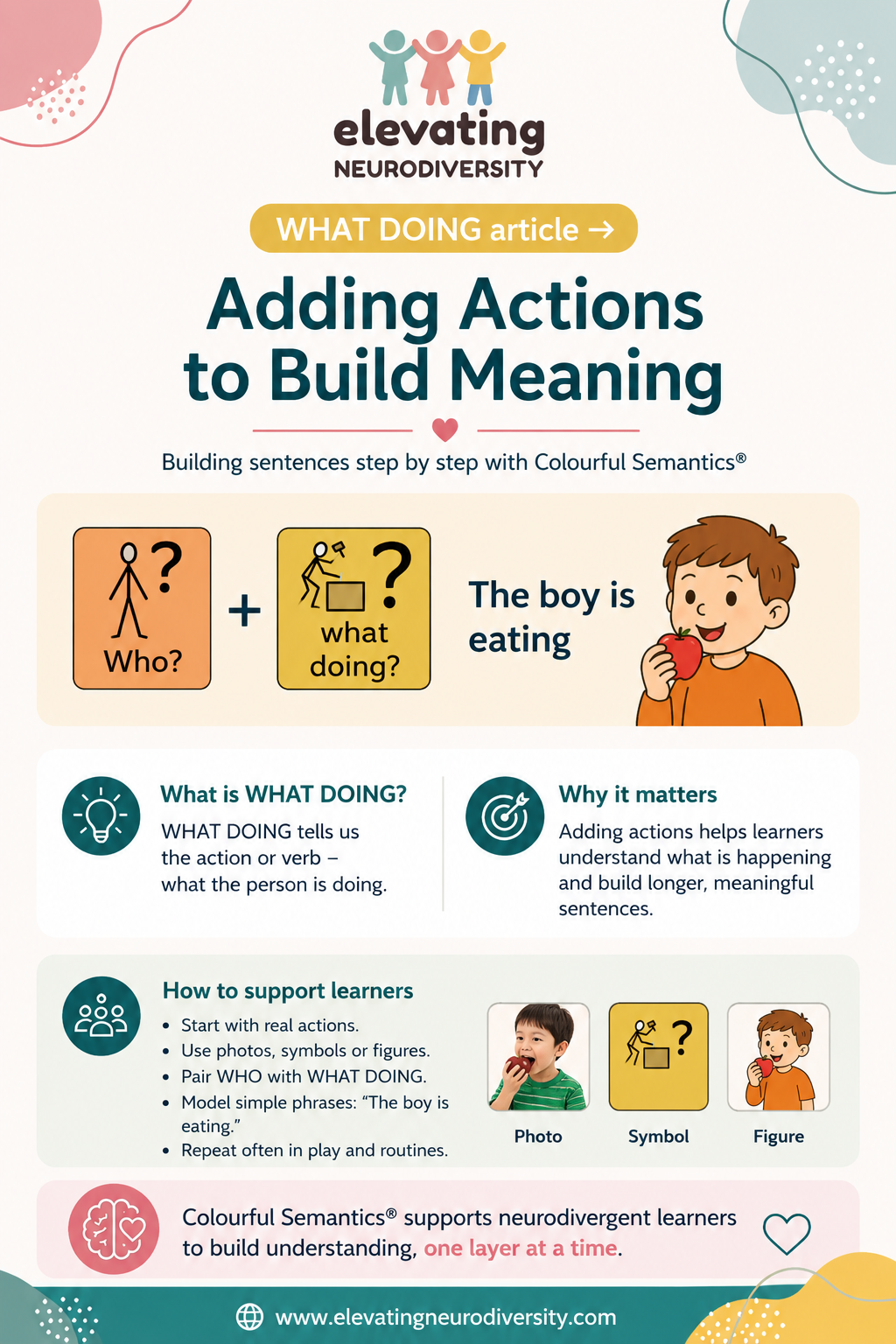
When WHO and WHAT DOING are brought together, the learner begins to connect a person, character or animal with an action. For example:
The boy + is jumping.
The dog + is sleeping.
Mum + is cooking.
For some learners, I introduce WHAT DOING through actions they can see, experience or take part in before expecting them to identify verbs from pictures alone. A learner might watch someone jump, take part in painting or notice a familiar adult reading. The yellow WHAT DOING cue can then help draw attention to the action within that experience.
I use the term WHAT DOING rather than beginning with grammatical terminology such as verb. The aim is to help the learner notice what is happening and connect that action with the person, character or animal involved.
As understanding develops, the same yellow visual cue can be used across different actions, people and contexts, helping learners begin to recognise the role of WHAT DOING within a wider message.
Why Identifying Actions Can Be Hard for Some Learners
Identifying an action can involve more than recognising what is shown in a picture. A learner needs to notice what is happening, understand which part of the scene is relevant and connect that action with the person, character or animal involved.
Actions can also look different depending on the context. Running may look different when it is performed by a child, an animal or a favourite character. The same action may also be represented differently in a photograph, symbol, illustration or real-life experience. Recognising these different examples as the same underlying action may take time and experience.
The language used to describe an action can add another layer of complexity. A learner may understand an action when they see or experience it without yet using the corresponding word, symbol or form of communication independently. This is why I do not assume that difficulty naming a verb means the learner does not understand what is happening.
Busy images can also make the action harder to notice. If a scene contains several people, objects and actions, the learner may need support to identify which part of the image the WHAT DOING question is asking them to focus on.
For these reasons, I look beyond whether a learner can correctly name an action from a picture card. I consider whether they notice what is happening, recognise the action across different contexts and can show their understanding in a way that is accessible to them.
Preparing to Teach the WHAT DOING Layer
Before I begin a structured WHAT DOING activity, I think about which actions are already familiar and meaningful to the learner and how clearly those actions can be represented.
I may begin with actions the learner regularly experiences or sees, such as eating, drinking, jumping, running or sleeping. For another learner, actions connected to a particular interest, familiar person or favourite character may provide a more meaningful starting point. I choose examples according to the individual learner rather than working through a predetermined list of verbs.
I also consider how the action is presented. A photograph, symbol or illustration that appears clear to me may not be immediately meaningful to the learner. Where possible, I choose representations that make the action easy to notice and reduce unnecessary visual information that could compete for attention.
The number of choices matters too. One learner may initially benefit from choosing between two clearly different actions, while another may be ready to identify WHAT DOING from a wider range of options or within a more complex scene.
The yellow WHAT DOING colour can provide a consistent visual reference, but the colour itself does not teach the meaning of an action. I use it alongside meaningful examples and the repeated WHAT DOING question so that the learner can begin connecting the visual cue with the idea of noticing what is happening.
Preparing to teach WHAT DOING is therefore less about assembling a particular set of verb cards and more about choosing actions, representations and a level of support that give the individual learner the best opportunity to understand what the question is asking.
Teaching WHAT DOING Through Real Actions and Everyday Experiences
When I introduce the WHAT DOING layer, I look for opportunities to connect actions with experiences that are already happening throughout the learner’s day.
Real movement can provide an immediate context for the WHAT DOING question. A learner might jump, clap, run, stir, pour or paint while I model the action using spoken language, AAC or other visual support. I can then use the yellow WHAT DOING cue to draw attention to what is happening without turning every interaction into a question that requires an answer.
Everyday routines also provide repeated opportunities to notice actions in meaningful contexts. During snack time, someone may be eating, drinking, pouring or opening. During play, a character may be jumping, driving or sleeping. In the classroom, a learner or adult may be cutting, writing, painting or reading. The actions I focus on will vary according to the learner and what is genuinely relevant within their day.
I also use familiar people, characters and interests when they help make an action more meaningful. A favourite character can perform different actions, or photographs from a real classroom experience can be revisited afterwards to notice what someone was doing.
As learners encounter the same action across different contexts, I can begin to vary who is doing it and how it is represented. Jumping might first be experienced by the learner, then seen when a familiar adult jumps, and later recognised in a photograph, illustration or story. This can help the learner encounter the same underlying action without becoming dependent on one practised image.
The aim is not simply to teach a list of verbs. I want learners to begin noticing actions as part of meaningful experiences and to connect what is happening with the person, character or animal involved.
What Teaching the WHAT DOING Layer Looks Like in My Classroom
In my specialist classroom, teaching WHAT DOING does not always look like a planned verb activity. I use actions that are already happening throughout the school day and draw attention to them in ways that are appropriate for the individual learner.
During a practical activity, I might model words such as pouring, mixing or cutting as the actions happen. During play, I may comment on what a learner, adult or character is doing. At other times, I use photographs taken during familiar classroom experiences and revisit them afterwards, helping the learner notice both who was involved and what they were doing.
I also model the WHAT DOING question without always expecting an immediate response. If someone is jumping, I can use the yellow cue, model “jumping” and connect the action with the person who is doing it. This allows learners to encounter the structure through repeated meaningful experiences without every interaction becoming a test.
The same framework can be used across very different levels of learning. One learner may be choosing between two clearly different actions, while another may be combining WHO and WHAT DOING to create a short message. A learner working with more complex language might use the same structure to explore actions within a story, photograph or curriculum topic.
I also use learner interests where they create meaningful opportunities for language. A favourite character, toy or topic can provide a familiar context for exploring different actions, but I vary the people, characters and situations over time so that understanding is not tied to one activity or set of images.
What this looks like therefore changes from learner to learner. The yellow WHAT DOING cue provides a consistent reference point, while the activity, language, communication method and level of support remain flexible.
Recognising Different Ways of Responding
Understanding the WHAT DOING layer does not need to be demonstrated by naming an action through spoken language. A learner may understand what is happening before they can independently use the corresponding word, symbol or other form of communication.
A learner might point to or select an action image, choose between symbols, use eye gaze, demonstrate the action themselves, use AAC, say a word or communicate through a combination of methods. I consider whether the learner is showing an understanding of what is happening rather than expecting one particular type of response.
I also consider the learner’s existing communication system and how the yellow WHAT DOING cue can work alongside it. Colourful Semantics can provide additional visual structure, but it should not replace the learner’s established ways of communicating.
At times, I may model the action without expecting the learner to respond at all. Repeatedly seeing, experiencing and hearing language connected with meaningful actions can be part of the teaching process without every interaction becoming a test.
By recognising different ways of responding, I can focus more clearly on the concept I am actually teaching: noticing and communicating what is happening within the message.
How to Support Learners Who Are Finding the WHAT DOING Layer Difficult
If a learner is finding the WHAT DOING layer difficult, I first look at what the activity is asking them to process. The difficulty may not be with understanding actions themselves. The action may be unfamiliar, the image may be difficult to interpret, there may be too many choices, or the learner may not yet understand what the WHAT DOING question is asking them to notice.
I may return to an action the learner can experience directly and model it as it happens. Actions such as jumping, clapping, pouring or stirring can provide a clearer context than repeatedly presenting a static image and asking the learner to identify what is happening.
I also consider whether the visual representation is making the action clear. A photograph, symbol or illustration may capture only one moment within an action and may not be meaningful to the learner. I might change the image, use a short video or demonstrate the action in real time before returning to a visual representation.
If there are too many possibilities, I may reduce the number of choices or use actions that are clearly different from one another. I also look at whether the learner recognises the person, character or context shown, as unfamiliar information can make it harder to focus on the action itself.
A learner may understand an action in one context without yet recognising it somewhere else. If they identify jumping when they perform the action themselves but not when a character is jumping in a picture, I provide opportunities to encounter the same action across different people, characters, experiences and representations.
Most importantly, I do not respond to difficulty by simply repeating the same verb cards more often. I change the context, representation, amount of information or way I am presenting the action and look closely at what helps the individual learner make sense of WHAT DOING.
A Note About Gestalt Language Processors
Some learners may process and develop language in ways that do not fit neatly within a word-by-word sentence-building pathway. For learners described as gestalt language processors, separating a message into individual elements such as WHO and WHAT DOING may not reflect how they naturally acquire or use language.
A learner may communicate an action through a meaningful phrase or longer chunk of language without yet being ready to analyse that message and rebuild it one word at a time. I would therefore not assume that a learner needs to isolate or label individual actions simply because they are using language that includes them.
If I use Colourful Semantics with a learner who communicates through gestalts or longer chunks of language, I consider whether the yellow WHAT DOING structure is genuinely supporting their understanding and communication. I would not use it to break down or correct meaningful gestalts simply to fit them into a colour-coded sentence structure.
As learners begin generating more flexible, self-generated language, Colourful Semantics may become a useful visual support for some learners. At this stage, the WHAT DOING layer may help make the action within a message more visible and support the learner as they explore how different parts of a sentence work together.
As always, I consider the individual learner’s communication profile and work alongside their speech and language therapist where appropriate. Colourful Semantics can be one tool within a wider communication approach, but it should not replace the learner’s existing communication system or meaningful interaction.
Evidence-Informed Practice
Colourful Semantics was developed by speech and language therapist Alison Bryan and described in her 1997 chapter, Colourful Semantics: Thematic Role Therapy. The approach uses colour coding to make different thematic roles within a sentence more explicit. Within the pathway I use, the yellow WHAT DOING layer draws attention to the action within the message.
A later clinical investigation by Bolderson, Dosanjh, Milligan, Pring and Chiat (2011) explored the use of Colourful Semantics with six children aged five and six who had language difficulties. The researchers reported encouraging changes in sentence production, but the study involved a very small group and did not specifically investigate autistic learners or the WHAT DOING layer in isolation.
For this reason, I do not assume that teaching actions through Colourful Semantics will work in the same way for every learner. I use the framework alongside ongoing observation of the individual learner, adapting the actions, visual representations, contexts and level of support according to what helps them understand and communicate.
The evidence base for Colourful Semantics remains limited, so I see the yellow WHAT DOING structure as a teaching tool rather than a guaranteed intervention. What matters in my classroom is whether it is helping the individual learner notice, understand and communicate what is happening in a meaningful way.
Further Reading
Bryan, A. (1997). Colourful semantics: Thematic role therapy. In S. Chiat, J. Law and J. Marshall (Eds.), Language Disorders in Children and Adults: Psycholinguistic Approaches to Therapy (pp. 143–161). London: Whurr.
Bolderson, S., Dosanjh, C., Milligan, C., Pring, T. and Chiat, S. (2011). Colourful semantics: A clinical investigation. Child Language Teaching and Therapy, 27(3), 344–353.
What Comes After the WHAT DOING Layer?
As learners begin to connect WHO with WHAT DOING, I look for natural opportunities to add more information to the message. The green WHAT layer can introduce the person, object or thing involved in the action. For example, a learner who is beginning to connect The girl + is eating may encounter The girl + is eating + an apple. A learner exploring The boy + is kicking might begin to notice The boy + is kicking + the ball.
A learner does not need to completely master WHO and WHAT DOING before encountering the WHAT layer. In everyday experiences, actions often involve people and objects together, and these connections can develop alongside continued support with the earlier layers.
The amount of support will vary. One learner may continue to use clear orange WHO and yellow WHAT DOING prompts while beginning to explore objects, while another may be ready to combine several elements within a longer sentence or visual structure. I introduce additional layers according to what is meaningful and accessible for the individual learner rather than treating progression as a fixed sequence that must be completed at the same pace by everyone.
My guide to teaching WHAT in Colourful Semantics explores how I introduce the green object layer and support learners to add more information to their messages.
Explore the WHAT DOING Colourful Semantics Resource
If you are looking for structured visual activities to support the WHAT DOING layer, you can explore my Colourful Semantics WHAT DOING resource alongside the teaching approach in this guide.
The activities provide opportunities to explore and practise actions using visual support, while allowing you to adapt the level of choice and support according to the individual learner.
Final Thoughts
The yellow WHAT DOING layer can help learners notice and communicate what is happening within a message, but meaningful teaching involves more than learning a list of verbs or identifying actions from picture cards.
In my specialist classroom, I use real movement, everyday routines, meaningful experiences and carefully chosen visual support to make actions easier to notice and understand. I adapt the actions, representations, ways of responding and level of support according to the individual learner.
The aim is for WHAT DOING to become meaningful beyond a structured activity. As learners encounter actions across real experiences, photographs, play, stories and wider learning, the yellow WHAT DOING cue can provide a familiar structure for noticing and communicating what is happening.
From there, actions can connect naturally with WHO and other parts of the Colourful Semantics pathway, supporting learners to communicate increasingly detailed and meaningful messages.