When teachers ask me for Colourful Semantics activities, they’re often expecting a list of worksheets, games or printable ideas. While structured activities certainly have their place, the most powerful opportunities to develop language in my classroom happen long before anyone sits down at a table. They happen during morning routines, shared stories, choosing time, child-led play and the hundreds of everyday conversations that make up the school day.
Over the years, I’ve found that Colourful Semantics is most effective when it is embedded naturally into everyday teaching rather than used only during a timetabled intervention. In my classroom, the coloured symbols become part of our environment and our conversations. Children encounter who, what, what doing, where, what like and when throughout the day, giving them repeated opportunities to hear, understand and gradually use sentence structures in contexts that make sense to them.
In this guide, I’ll share the practical ways I use Colourful Semantics every day with autistic and neurodiverse learners, helping you embed the approach naturally into classroom routines, play and learning while using structured activities purposefully to support spoken and written language.
Why Worksheets Aren’t Enough
Structured activities such as photo matching, symbol matching and sentence-building tasks remain an important part of my teaching. However, I see them as opportunities to reinforce and generalise language that children have already experienced through real communication, not as the starting point for learning.
In this guide, I’ll share the practical ways I use Colourful Semantics every day with autistic and neurodiverse learners, helping you embed the approach naturally into classroom routines, play and learning while using structured activities purposefully to support meaningful spoken and written language.
Build a Colourful Semantics Classroom
Before planning activities or preparing worksheets, think about the language environment you want to create. In my classroom, Colourful Semantics isn’t something we only use during a planned intervention. It’s woven into the day so that children encounter the coloured symbols naturally, wherever meaningful communication happens.
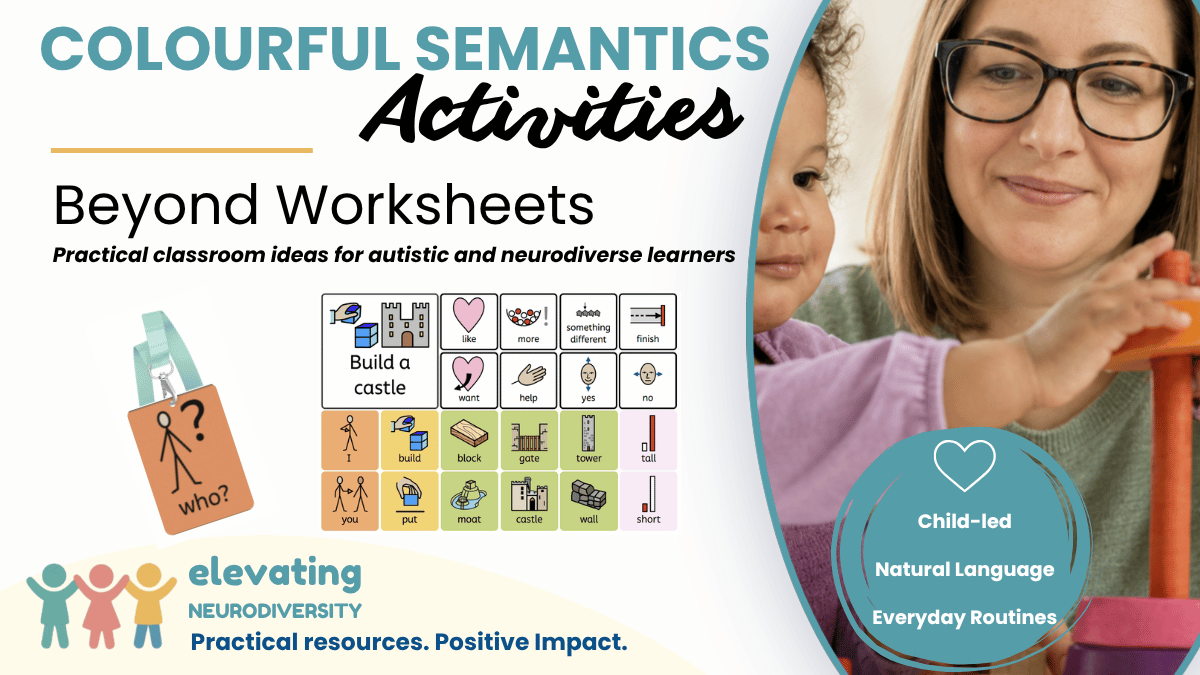
One of the simplest ways I do this is by wearing the Colourful Semantics symbols on a lanyard. As I talk with children, ask questions or model language, I can quickly show the relevant symbol alongside my spoken words. This gives children a consistent visual cue without interrupting the flow of the interaction.

The classroom itself also reinforces the language we use every day. During morning circle time, we talk about who is in school and who is absent, using our WHO display with photographs of pupils and staff. During choosing time, children use a visual choice board supported by the WHAT symbol to help them communicate what they would like to play with. Around the classroom, the WHERE symbol appears above our board showing where pupils and staff are if they are not in class, while the WHAT LIKE? symbol supports discussions about emotions alongside our Zones of Regulation display. A WHEN symbol beside the classroom clock helps children make sense of routines and transitions throughout the day. As the children are engaged in activities we use the oppportunity to talk about the actions and when appropriate link it to the WHAT DOING card.
Displays and lanyard symbols aren’t there simply to decorate the classroom or remind children of the different colours. Instead, they provide authentic opportunities to hear, understand and use language within familiar routines. As children encounter the symbols across different contexts, they begin to recognise that they represent ideas they experience every day rather than concepts linked to a single activity or worksheet.
The adults are just as important as the environment. In our classroom, everyone uses the same symbols and follows a shared approach to modelling language. New staff quickly learn that Colourful Semantics isn’t about asking children to identify coloured symbols at every opportunity. Instead, it’s about recognising natural opportunities to model language, allowing children time to process what they hear and supporting communication throughout the day. When the whole team works this way, Colourful Semantics becomes part of the classroom culture rather than another intervention to fit into the timetable.
Colourful Semantics Activities Throughout the School Day
One of the biggest changes I made as a teacher was to stop thinking about Colourful Semantics as something I teach and start thinking about it as something I use. Instead of saving it for a planned intervention, I look for meaningful opportunities throughout the day to model language, support understanding and gradually build children’s sentence structures.
The school day naturally begins with opportunities to explore WHO. During morning registration, we discuss who is in school, who is absent and which adults are working in the classroom. Our WHO display, showing photographs of pupils and staff, provides a visual reference because the question genuinely matters to the children. Rather than identifying people to complete an activity, they’re talking about the people they know and interact with every day.
Choosing time naturally introduces the WHAT layer. Visual choice boards support children to communicate what they would like to play with, while adults model the language alongside the matching symbol. Because these choices are genuine, children quickly discover that language helps them express what they want and need.
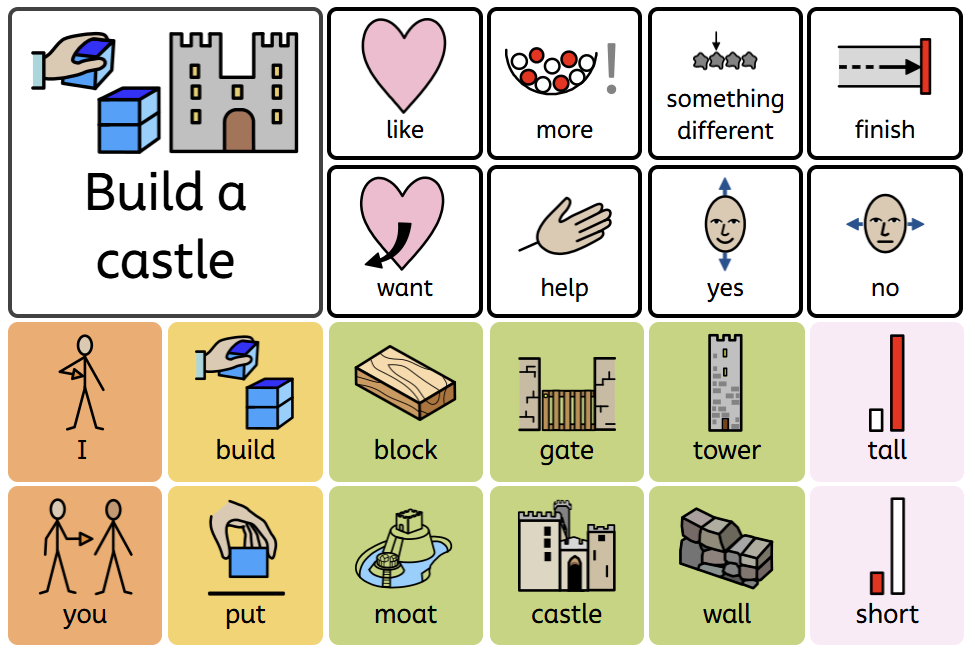
Some of the richest opportunities for language happen during child-led play. Rather than interrupting play with lots of questions, I sit alongside children, observe what captures their attention and model short, meaningful language. If a child is jumping on the trampoline, I might simply comment, “You’re jumping.” As their understanding develops, I gradually expand the sentence by adding one meaningful piece of information at a time. “Jack is jumping.” “Jack is jumping on the trampoline.” “Jack is jumping high on the trampoline outside.” The language grows naturally from the experience rather than expecting the child to produce a longer sentence straight away.
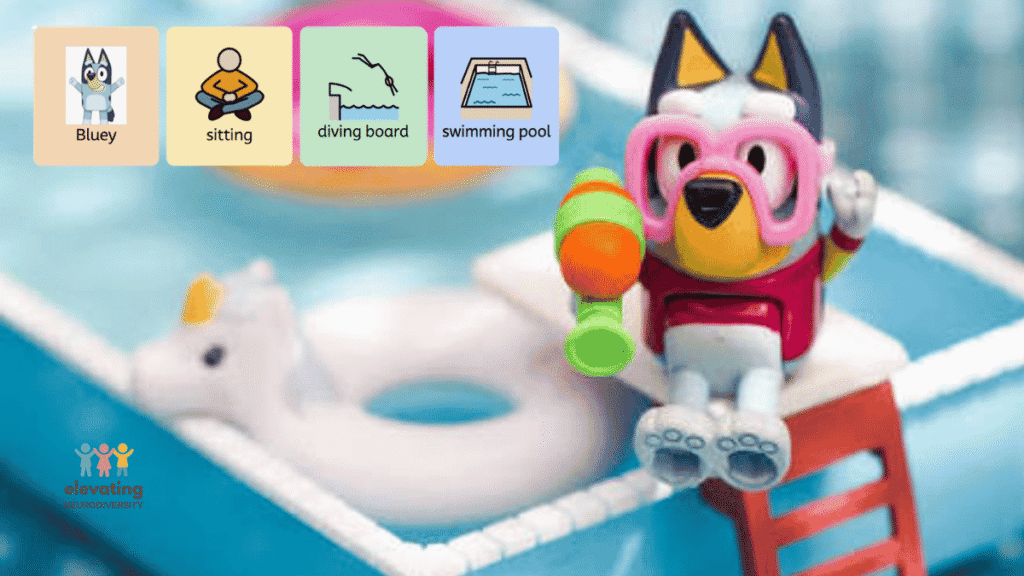
Following children’s interests can make an enormous difference. One learner I taught showed very little interest in traditional matching activities. Instead of asking him to match symbols to photographs, we joined him in playing with his favourite Bluey characters and playsets. We naturally introduced Colourful Semantics by asking simple questions such as, “Who is it?” or “Where is Bluey?” while modelling complete answers ourselves. As we moved the characters around the playsets, we commented on what they were doing, always giving the child plenty of time to process what they had heard without expecting them to repeat it. As their understanding grew, we introduced symbol mats, then photographs of the same toys and eventually more structured matching activities. Because the learning began through motivating play, the child gradually started using Colourful Semantics more independently and generalised those skills into other parts of the classroom.
Colourful Semantics also supports everyday routines beyond play. We talk about where people are using our classroom location board, discuss what like during emotional check-ins using our Zones of Regulation display, and refer to when events are happening as we move through the daily timetable. These moments only take a few seconds, but over time they provide hundreds of opportunities for children to hear and experience language in meaningful contexts.
Not every moment needs to become a teaching moment. If a child is deeply engaged in play, developing a play schema or enjoying a shared interaction, I don’t interrupt simply to ask a Colourful Semantics question. Regulation, connection and engagement always come first. The opportunities to model language will come, and when they do, they are far more meaningful because they are rooted in the child’s experience.
Model Language Naturally
One of the biggest misconceptions about Colourful Semantics is that children need to repeat every modelled sentence for learning to take place. In my experience, that’s rarely how language develops. Instead, I focus on providing consistent, meaningful language models while giving children the time and space they need to process what they hear.
When I’m modelling language, I keep my sentences short, purposeful and relevant to what the child is experiencing in that moment. Rather than asking repeated questions or expecting an immediate response. This keeps the interaction natural and reduces the pressure to perform.
After modelling, I deliberately pause. It’s tempting to fill the silence or repeat the question, but many autistic and neurodiverse learners need extra processing time before responding. I often count silently to ten before deciding whether another model is needed. Sometimes a child responds with a word, a gesture or by looking towards the object I’m talking about. Sometimes they don’t respond at all. That doesn’t mean the learning hasn’t happened.
I never expect children to repeat my sentences simply because I’ve modelled them. Repetition can be valuable for some learners, but it isn’t the only sign that language is developing. Some children will begin to use new words independently after hearing them modelled during everyday interactions. Others may first demonstrate understanding by pointing, making a choice, using AAC, looking towards a symbol or acting out what they’ve heard. Every attempt to communicate tells us something about what the child understands, and every form of communication deserves to be acknowledged and valued.
This approach is particularly important when supporting learners with different communication profiles, including Gestalt Language Processors. Some children naturally develop language by acquiring and gradually reshaping larger chunks of language rather than single words. For these learners, hearing rich, meaningful models within motivating experiences is often more supportive than repeatedly prompting them to produce individual words or sentence structures. Colourful Semantics can still provide a helpful visual framework, but it should always support communication rather than becoming the focus of the interaction.
Ultimately, my goal isn’t for children to build perfect Colourful Semantics sentences. My goal is to help them become confident communicators. Sometimes that means celebrating a spoken sentence. Other times it means recognising the importance of a point, an eye gaze, a symbol selection, a gesture or a message communicated through AAC. When we respond to all communication as meaningful, we create an environment where children feel understood, respected and motivated to communicate again.
Why This Approach Is Evidence-informed
While research specifically exploring the use of Colourful Semantics throughout the entire school day is still limited, the approach described in this guide is informed by a wider body of evidence supporting naturalistic language intervention for autistic learners.
Studies have shown that language develops most effectively when adults model communication during meaningful routines, play and everyday interactions rather than relying solely on structured teaching activities. Naturalistic Developmental Behavioural Interventions (NDBIs), responsive interaction strategies and other naturalistic language approaches have been associated with improvements in language, social communication and engagement for many autistic children.
This is why, in my classroom, Colourful Semantics is woven throughout the day rather than being confined to a single intervention session. Structured activities remain an important part of teaching, but they are used to reinforce and generalise language that children have already experienced through authentic communication, shared experiences and motivating activities.
As with all educational approaches, teaching should always be adapted to the individual learner’s communication profile, strengths, interests and support needs.
Learn More
- Schreibman, L., Dawson, G., Stahmer, A. C., et al. (2015). Naturalistic Developmental Behavioral Interventions: Empirically Validated Treatments for Autism Spectrum Disorder. Journal of Autism and Developmental Disorders.
- Sandbank, M., Bottema-Beutel, K., Crowley, S., et al. (2020). Project AIM: Understanding the Effects of Naturalistic Developmental Behavioral Interventions. Autism Research.
- Crank, J., Sandbank, M., Dunham, K., et al. (2019). Meta-analysis of Naturalistic Developmental Behavioral Interventions for Young Children with Autism Spectrum Disorder. Autism.
- Crowe, K., Machalicek, W., et al. (2024). The Effect of Naturalistic Developmental Behavioral Interventions and Aided AAC on the Language Development of Children on the Autism Spectrum with Minimal Speech.
Introduce Structured Activities with Purpose
Structured Colourful Semantics activities have an important place in my classroom, but they aren’t where learning begins. Instead, I introduce them once children have experienced the language through meaningful interactions, routines and play. By that stage, the symbols and sentence structures already have a purpose because children have encountered them in real-life situations.
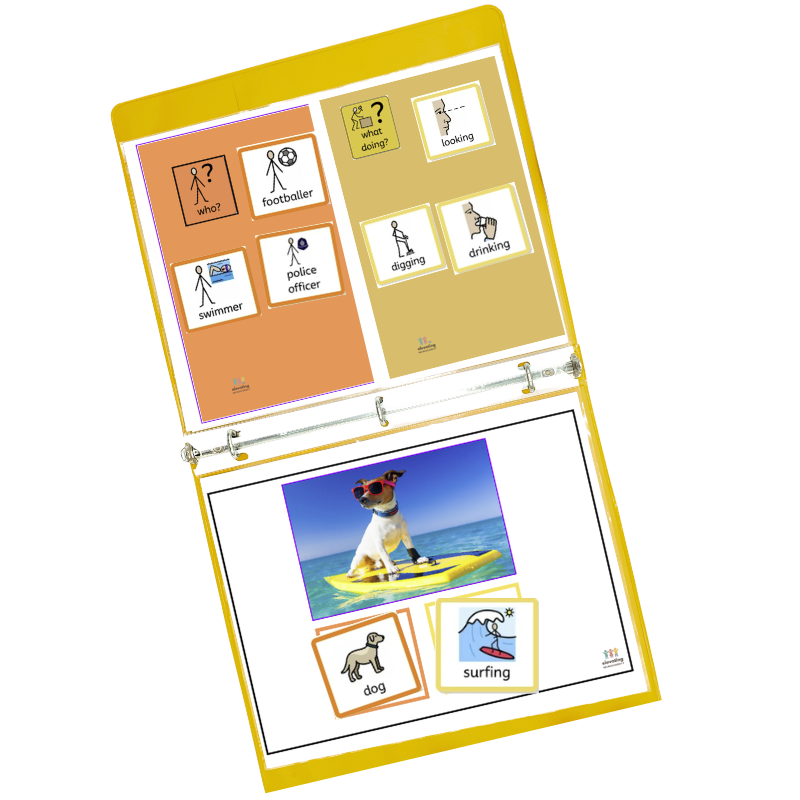
For many learners, I begin with familiar photographs of people, favourite toys or everyday classroom objects before introducing more structured matching activities. Using meaningful images helps children connect the coloured symbols to experiences they already understand, making the transition into table-top activities much more successful.
As children’s understanding develops, we gradually move towards more structured tasks such as photo matching, symbol matching, sentence-building activities and simple worksheets. Rather than expecting children to master every layer at once, I focus on one Colourful Semantics stage at a time while continuing to model the complete sentence naturally throughout the day. This balance allows children to build confidence without becoming overwhelmed. It’s important to note that the creator of Alison Bryan does not advocate the use of this approach to strictly teach Subject-Verb-Object (SVO) sentences and we should be mindful that spoken language does not follow the SVO structure.
Structured activities also give me valuable opportunities to observe what children understand and where they may need additional support. They can reveal whether a learner recognises familiar vocabulary, understands a particular sentence component or is ready to move on to the next stage. If a child confuses different layers or finds an activity difficult, I don’t increase the demands. Instead, I simply return to modelling those concepts during everyday interactions before trying again another day.
It’s important to remember that completing an activity successfully isn’t the end goal. A child who can accurately match symbols on a worksheet still needs opportunities to use that language during play, conversations, shared reading and daily routines. Equally, a child who isn’t yet ready for structured activities may still be making excellent progress through listening, observing and communicating in other ways.
We also need to be mindful that completing an activity successfully isn’t the end goal. A child who can accurately match symbols on a worksheet still needs opportunities to use that language during play, conversations, shared reading and daily routines. Equally, a child who isn’t yet ready for structured activities may still be making excellent progress through listening, observing and communicating in other ways.
Ready to try structured activities?
Support each stage of Colourful Semantics with printable resources designed for autistic and neurodiverse learners.
Supporting Every Communicator
Every child communicates differently, and one of the strengths of Colourful Semantics is that it can be adapted to meet a wide range of communication needs. The approach doesn’t have to change because a child uses AAC, eye gaze, gestures or echolalia. Instead, we adapt how we model language while keeping communication meaningful and enjoyable.
Some children may respond by speaking, while others might point to a symbol, select vocabulary on an AAC device, use eye gaze or communicate through gesture. Every response provides valuable information about what a child understands and should be recognised as meaningful communication. Communication isn’t measured by speech alone, and every successful interaction helps us understand how best to support the learner.
For Gestalt Language Processors, Colourful Semantics can provide a helpful visual framework alongside natural language modelling. Rather than expecting children to produce individual words or repeat modelled sentences, the focus remains on providing meaningful language within motivating experiences. Over time, many children begin to recognise and use sentence structures in ways that reflect their own stage of language development.
The same principle applies to every learner. We meet children where they are, celebrate every attempt to communicate and gradually build understanding through consistent modelling and meaningful interactions. The goal isn’t for every child to communicate in the same way. It’s to ensure every child has opportunities to understand language, express themselves and experience successful communication in whatever form works best for them.
Final Thoughts
Colourful Semantics is far more than a collection of colour-coded symbols or structured activities. At its heart, it’s a framework for helping children understand and use language in everyday life.
The biggest impact rarely comes from a worksheet or a planned intervention alone. It comes from the conversations we have during play, the comments we make during routines, the time we give children to process language and the relationships we build every day. When Colourful Semantics becomes part of those interactions, children have repeated opportunities to develop communication in ways that feel authentic, purposeful and achievable.
Whether you’re just beginning to use Colourful Semantics or refining your current practice, remember that language grows through shared experiences, curiosity and connection. The coloured symbols simply give us another way to support that journey.
Looking for the structured resources?