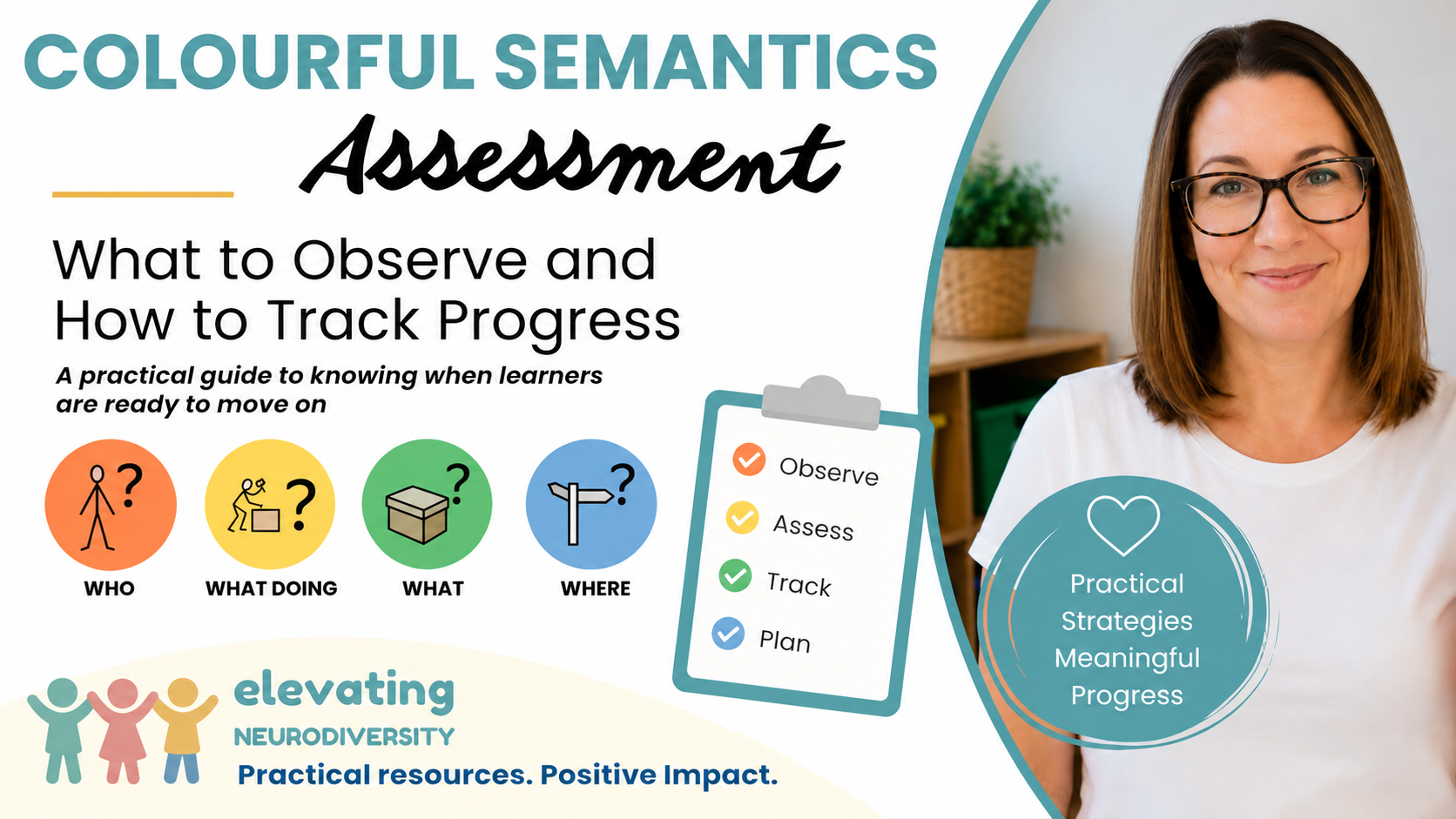
Colourful Semantics assessment isn’t about deciding whether a learner has completed a particular layer. It’s about understanding how they are developing as communicators and using those observations to plan the next achievable step. Colourful Semantics is about much more than completing activities or building longer sentences. Effective teaching depends on introducing the next step at the right time, providing enough support for learners to be successful while continuing to extend their language in meaningful ways.
You can find out more about the approach in the Colourful Semantics Explained article.
In my specialist classroom, assessment is something that happens every day instead of at the end of a unit of work. I am constantly observing how learners understand and use language during play, routines, conversations and structured teaching activities. Those observations tell me far more than a completed worksheet ever could.
In this guide, I’ll share what I look for when assessing progress in Colourful Semantics, how I decide when learners are ready for the next layer, and why ongoing observation is one of the most valuable assessment tools we have when supporting autistic and neurodiverse learners.

Why Colourful Semantics Assessment Matters
Assessment in Colourful Semantics isn’t about proving that a learner has completed a level. It helps us understand what they can already do independently and what they are ready to learn next.
Effective assessment prevents us introducing language that is too difficult while also avoiding unnecessary repetition once learners are ready for greater challenge. Vygotsky’s (1978) concept of the Zone of Proximal Development reminds us that learning is most effective when teaching builds on what learners can almost achieve with support.
It’s important to note that Colourful Semantics assessment should sit alongside your wider understanding of the learner’s communication strengths, needs and everyday interactions.
I don’t ask whether a learner has finished a Colourful Semantics layer. Instead, I’m always asking myself, “What is the next achievable step for this learner?” That question guides every teaching decision I make.
What Should You Observe?
When assessing progress in Colourful Semantics, I am not looking for a learner to complete a worksheet perfectly or simply repeat a sentence I have just modelled. What I really want to know is whether they are beginning to organise language and use it more independently. To help me answer that, I focus on three key areas.
Independence
Can the learner communicate their thoughts and ideas with less adult support? Are they beginning to combine Colourful Semantics layers more independently?
If you’d like to explore how each layer develops, these guides explain the progression from WHO to WHERE:

Understanding
Can they understand the vocabulary and meaning being communicated rather than simply repeating modelled language? I look for evidence of both receptive and expressive language.
Generalisation
Perhaps the most important question I ask is whether learners are beginning to use their developing language beyond the teaching session. Are they communicating during play, routines and everyday conversations without being prompted? For me, those spontaneous moments are the strongest evidence that learning is beginning to transfer into meaningful communication.
How Do You Know When a Learner Is Ready to Move On in Colourful Semantics?
One of the questions I’m asked most often is whether learners should master one Colourful Semantics layer before moving on to the next. In my experience, the answer is no. I don’t wait for perfection. Instead, I look for signs that a learner has a secure foundation and is ready for the next achievable step.
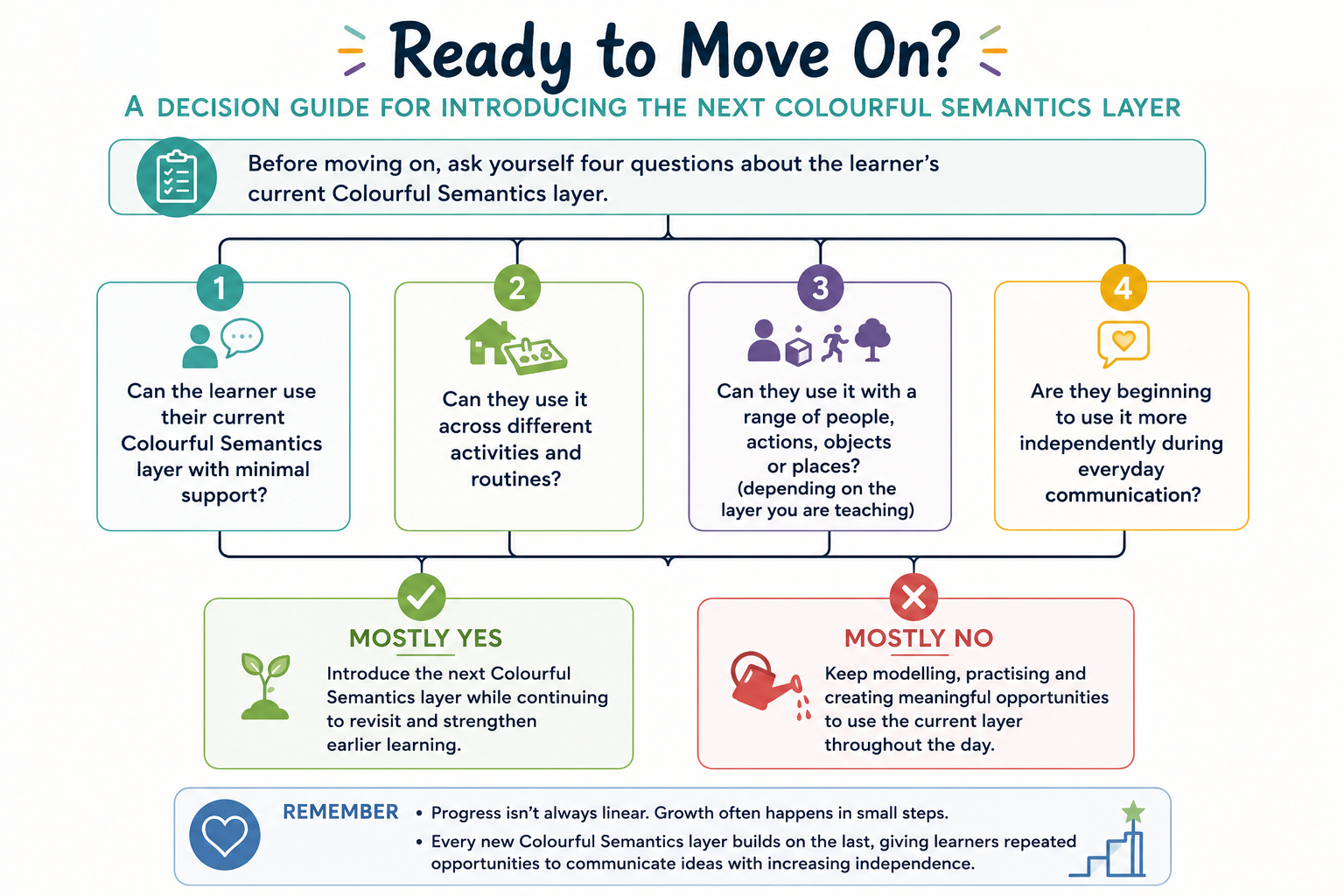
Before introducing another Colourful Semantics layer, I ask myself four questions:
Can the learner use their current Colourful Semantics layer with minimal support?
Can they use it across different activities and routines?
Can they use it with a range of people, actions, objects or places, depending on the layer I’m teaching?
Are they beginning to use it more independently during everyday communication?
If the answer is mostly yes, I begin introducing the next layer while continuing to revisit and strengthen earlier learning.
This reflects Vygotsky’s (1978) concept of the Zone of Proximal Development, where learning is most effective when new skills are introduced just beyond what a learner can do independently, with appropriate support. Colourful Semantics is designed to scaffold language development, allowing learners to build on what they already know while gradually extending their ability to communicate ideas.
Moving on doesn’t mean leaving earlier learning behind. Every new Colourful Semantics layer builds on the last, giving learners repeated opportunities to strengthen familiar language patterns while gradually extending communication.
How I Track Progress in My Classroom
Assessment isn’t something I only do during a Colourful Semantics session. Some of the most valuable observations happen throughout the school day, when learners are communicating for a real purpose. I notice how learners communicate during play, snack time, outdoor learning, shared reading and everyday classroom routines. I might jot down a quick note, collect an occasional sentence sample or simply record a significant moment after the lesson.
The biggest signs of progress happen when I’m not expecting them. A learner might tell me where they left their coat, comment on what another child is doing or describe something they’ve noticed during play. Those spontaneous moments tell me far more than a completed activity because they’re using language for a real purpose.
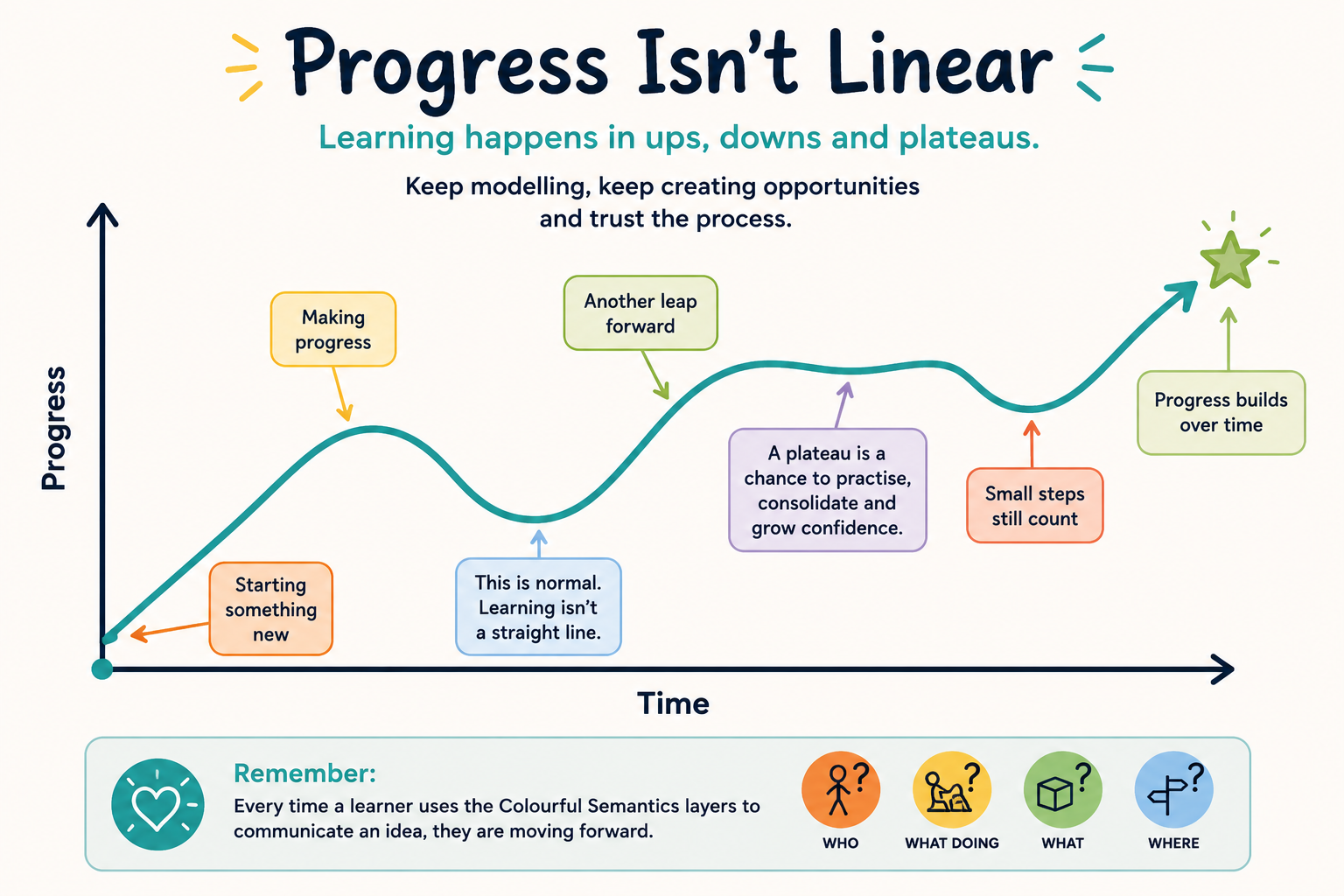
Those everyday moments help me decide whether it’s time to consolidate learning, introduce another Colourful Semantics layer or simply give a learner a little longer. More often than not, the biggest progress isn’t a longer sentence. It’s hearing a learner say something they couldn’t say a few weeks ago, or watching them communicate with less support than before.
A Note About Gestalt Language Processors
If you are supporting a Gestalt Language Processor (GLP), assessment should focus on how language is being used rather than how many Colourful Semantics layers a learner has completed. Progress may look different from learners who naturally develop language analytically. Instead of assessing whether a learner can produce a specific sentence structure on demand, look for increasing flexibility in their communication, a growing ability to adapt familiar gestalts to new situations and more opportunities for self-generated language. These are meaningful indicators that language is developing.
As with any learner, assessment should be individualised. Colourful Semantics can provide visual support for some GLPs, but it should always complement, rather than replace, approaches that respect their natural language development.
Evidence-Informed Practice
Although there is currently limited research specifically evaluating Colourful Semantics, many of the principles that underpin it, including explicit instruction, visual supports and scaffolded learning, are supported by a broader evidence base.
Vygotsky’s (1978) concept of the Zone of Proximal Development also provides a useful framework for assessment. By identifying what a learner can do independently and what they can achieve with appropriate support, teachers can introduce the next Colourful Semantics layer at a pace that is both achievable and appropriately challenging.
Together, these principles support an approach to assessment that helps teachers identify the next achievable step in a learner’s language development.
Final Thoughts
Assessing progress in Colourful Semantics is about far more than deciding whether a learner has completed a particular layer. It is about understanding how they are developing as communicators and using those observations to plan the next achievable step.
One of the things I enjoy most about teaching language is that no two learners ever follow exactly the same path. Some take small steps, others make sudden leaps, but every moment of new communication is worth celebrating. For me, that’s what assessment is really about. It’s noticing those moments and using them to decide what comes next.
If you’re looking for practical teaching ideas for each Colourful Semantics layer, explore the rest of this series, where I share the approaches, activities and classroom strategies that have worked in my own specialist practice with autistic and neurodiverse learners.